Why Should I Use Resource Management in Project Management Software?

Why Should I Use Resource Management in Project Management Software?

Resource management refers to the overall process of planning, scheduling, and allocating all your resources in a way that maximizes efficiency. Resource management as part of project management is all about optimizing your available project resources in a way that maximizes the likelihood of project success.
While resource management primarily focuses on managing your human resources, including employees and subcontractors, a resource is anything that’s needed to execute a task or project. Resources can include:
- Materials and supplies
- Tools and equipment
- Labor
Project management software that includes resource management allows you to achieve full visibility into each team member’s workload and availability. With this functionality, you can quickly see who’s doing what and determine who on your team is ready to take on more and who is over capacity. This visibility makes it easy for you to balance workloads effectively and prioritize project tasks in a way that optimizes your schedule without overworking your team.
Your project management software should allow you to visualize the overall high-level workload as well as drill down to see how task hours are allocated across individual team members.

The purpose of resource management
Resource management is centered around optimization and efficiency. Project management software with resource management functionality allows you to effectively plan the optimal way to use the available resources.
The ability to manage your resources effectively helps ensure the following:
- No one gets overloaded or sits idle
- Nothing gets missed
- Everyone can see what they’re expected to complete at what time
- The right tools, supplies, and materials are available when needed
Resource management helps you assign resources to project tasks, and manage task schedules to ensure that the right resources are ready to complete the work when it is planned to be done.
For instance, imagine you have a task scheduled for a building foundation to be dug, but the excavator was not booked in advance and is not available until next week. Plus, the only employee with excavation experience is assigned to another project for the rest of the month. You can quickly see how a failure to properly manage resources can cause a project to go off track.
Using resource management software allows you to better forecast team members’ commitments, visualize resource gaps, and ensure the necessary resources are acquired before they are needed.
Plus, resource management allows you to optimize workflows, which increases productivity and employee retention while decreasing the risk of project failure due to burnout and disengagement.
Resource management techniques
Resource management typically follows a three-step process:
- Allocation of resources
- Leveling of resources
- Smoothing of resources

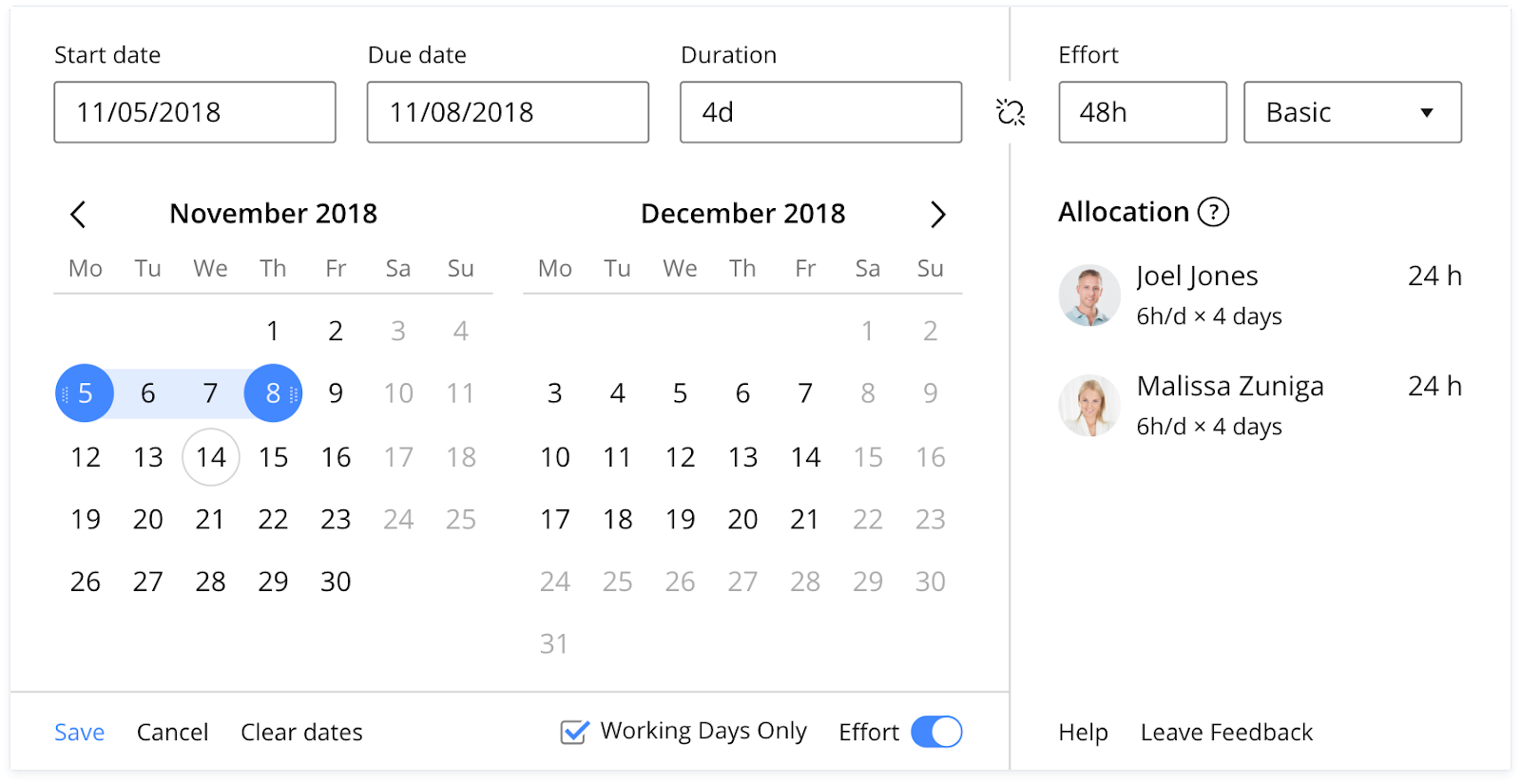
Resource allocation is the assignment of appropriate resources to the scheduled work. This process ensures the right resources are available when needed, and it helps you get the most from your available resources.
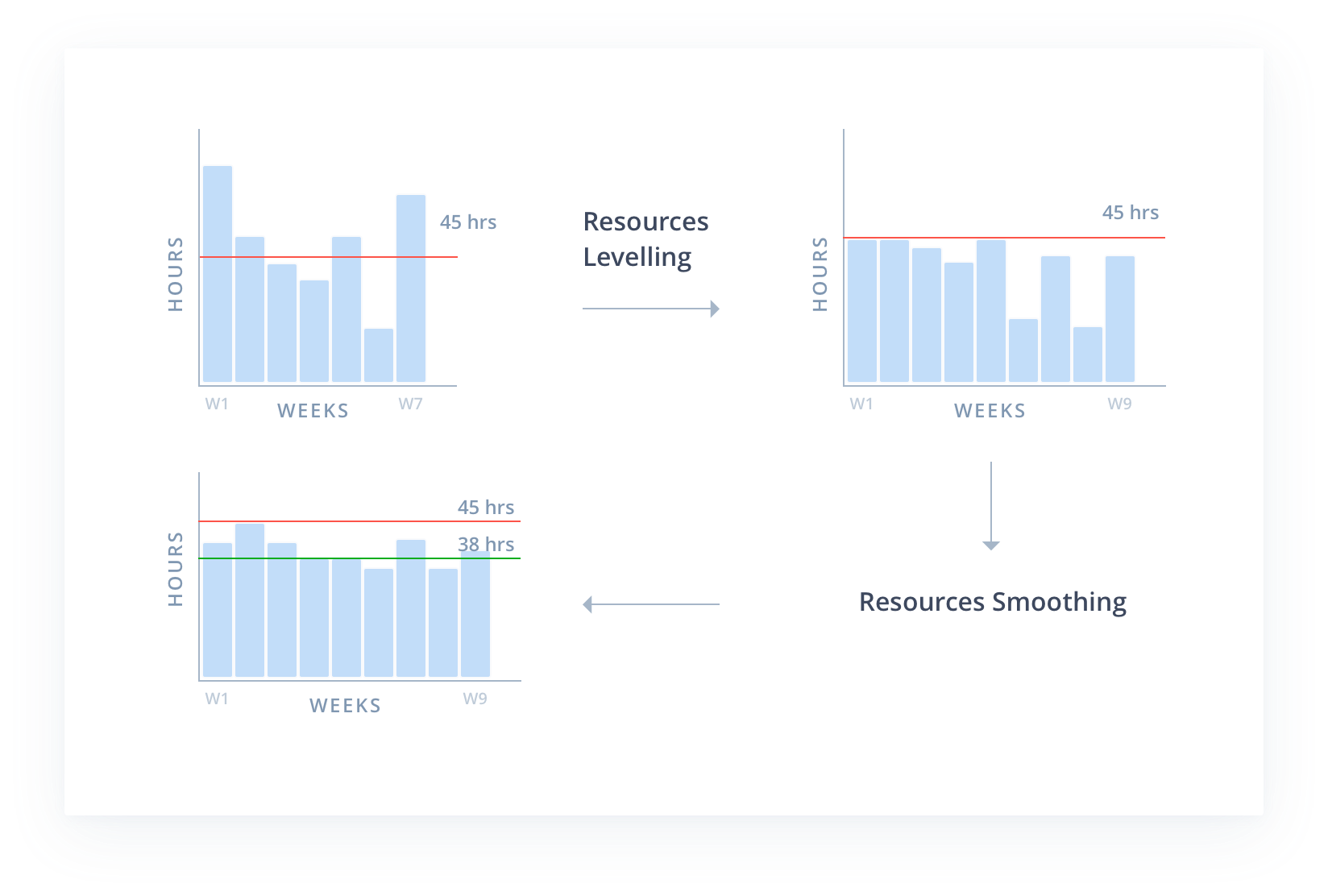
Resource leveling is the process of adjusting task start and finish dates based on any resource constraints. For instance, if you have work planned to start next month but the required materials will not arrive for six weeks, resource leveling is done to move out that task.
Another example is if you have two tasks planned at the same time, but they both require the same person to complete them, one may be brought forward or delayed. The goal of resource leveling is to balance resource demand with your available supply. Depending on the constraints, resource leveling may push out the critical path and project end date.
Resource smoothing is the technique used to adjust the scheduled work not to exceed certain predefined limits. The goal of resource smoothing is to smooth out the resource assignments across the length of the project.
For instance, if you notice that an employee has 40 hours of scheduled work for three weeks and 20 hours in one week, you may try to rearrange tasks to even the workload out to 35 hours every week.
Resource smoothing is meant to reduce “boom and bust” cycles in the project schedule and create a more even workload for everyone on the team. However, resource smoothing will only be done if it does not push out the critical path or the project end date.
The advantages of resource management in project management software
Resource management allows you to predict your future resource requirements before a project or task begins. A resource management plan is critical to optimizing people, materials, and budget efficiency. During the planning stages of resource management, resource forecasting determines the project’s scope, possible constraints, unforeseen costs, and potential risks.
This advanced planning and visibility enables you to avoid obstacles such as resource gaps. Effective resource management also allows you to avoid over-allocation or dependency on resources by gaining insight into your team’s workload.
Resource management software also builds transparency. Your team and other stakeholders can easily gain visibility into your team’s bandwidth. For example, if another project manager needs one of your team members for a task on their project, they can quickly see when that person is scheduled to become available and plan accordingly.
Good resource management involves understanding how much effort a task requires and picking the right person for the job. Resource management software provides insights into how long tasks take and the resources required to complete them. For instance, you can look back to a past project to check how long similar tasks took to complete, who completed them, and what other resources were required.
Plus, project management software allows you to continually monitor resource availability and progress in real-time. If you notice that a task is taking longer than expected, you can quickly re-prioritize work and redistribute hours across assignees to ensure no critical milestones are missed.
If an urgent work request comes in, you can use resource management features to see how that will impact your resource availability and adjust timelines and resources accordingly. This allows you to accommodate critical changes without burning out employees.
A flexible resource allocation tool allows you to distribute work hours to best suit each team member’s strengths and availability. You can even divide required task hours between team members if needed, to maximize efficiencies, enable your team to work collaboratively, and avoid project delays due to unbalanced workloads.
Beginning a project without the right resources in place can extend the end date of a four-month project to as much as a year, according to Gartner’s “Resource Capacity Planning for PPM Leaders: Crawl Before You Walk” report. That means without proper resource planning, your project can end up taking three times longer than expected.
By utilizing resource management tools and ensuring the right resources are available at the right time, you can avoid significant delays and drastically increase the likelihood of project success.
Critical success factors (CSFs) are the essential activities or areas that must be executed effectively for a project to achieve its goals. They help prioritize tasks, ensuring the project team focuses on what matters most and delivers high-quality results. By clearly defining CSFs, teams can align their efforts and increase the likelihood of overall project success.
Filters and search functions in project management software help you quickly find the specific tasks, reports, or project information you need without navigating through complex folders or menus. They allow you to focus on relevant data, monitor progress efficiently, and communicate critical updates to stakeholders. Using these tools saves time, reduces errors, and ensures your team stays organized and productive.
Live support in project management software gives you immediate access to expert assistance, helping resolve technical issues or answer questions in real time. It also allows team members to continue working while getting guidance, share files or resources instantly, and save conversations for future reference.
Using free trials in project management software lets you test all features without cost or long-term commitment, helping you evaluate usability, scalability, and fit before investing. Unlike freemium tools with hidden limits, free trials reduce financial risk, prevent poor purchasing decisions, and ensure the software meets your team’s real project needs.
Training resources in project management software help teams quickly learn how to use features effectively, follow best practices, and stay updated on system changes. They improve employee performance, reduce reliance on internal support, and prevent wasted time or inconsistent processes. Community forums and help centers also enable knowledge sharing and faster problem resolution.