Wrike logo.
    • For teams

      • Marketing

        Streamline proofing and reporting for seamless campaigns.

      • Creative & Design

        Create high-quality assets and get them approved in record time.

      • Product

        Accelerate your product process, from idea to delivery.

      • Client Services

        Exceed clients’ expectations with expert resources.

      • PMO

        Align strategy with execution and deliver results.

      • IT

        Execute initiatives, optimize workflows, and automate requests.

      • Operations

        Make work flow seamlessly with intuitive management tools.

      • HR

        Manage teams effortlessly with customizable HR features.

      • Legal

        Organize every file, case, and due date in one secure space.

      • Finance

        Centralize all financial tasks, from budgeting to invoicing.

      • See all teams

    • Workflows

      • Campaign Management

        Make marketing magic with end-to-end campaign management.

      • Agency Management

        Take full control of your agency management processes.

      • Client Service Delivery

        Get ahead of the competition with faster client services.

      • Product Lifecycle

        Watch your product lifecycle flow, from concept to customer.

      • Project Portfolio Management

        Manage your complete portfolio, from strategy to results.

      • Creative Production & Content

        Create, collaborate, proof, and approve all in one place.

      • Workflow Management

        Use custom statuses and automate your team workflows.

      • Project Management

        Plan Agile projects, track deadlines, and deliver results.

      • See all workflows

    • For industries

      • Technology

        Build solutions that matter, and deliver faster.

      • Manufacturing

        Enhance operations, accelerate production, and empower teams.

      • Professional Services

        Organize clients, streamline projects, and automate workflows.

      • Finance

        Deliver better, faster financials with automations.

      • Healthcare

        Collaborate cross-functionally in a secure setting.

      • Education

        Unite multiple disparate teams, departments, and colleges.

      • Construction

        Streamline building projects, from scoping to invoicing.

      • Media & Entertainment

        Choose one powerful platform for fast-paced work.

      • See all industries

    • Explore Wrike

      • Take a Product Tour

      • Book a Demo

      • ROI Calculator

      • Customer Stories

      • Start with Templates

    • Features

      • Dashboards

        Fuel better, faster, data-driven decisions with powerful analytics.

      • AI

        Learn about powerful AI and automations with Work Intelligence®.

      • Wrike Whiteboard

        Turn inspiration into execution with powerful visualization tools.

      • Gantt Charts

        Interactive project scheduling across teams.

      • Automation

        Define and trigger automated workflows to eliminate manual efforts.

      • Proofing

        Streamlined proofing and collaboration in one place.

      • Project Resource Planning

        Plan and allocate resources for timely delivery.

      • Project Views

        Get the full picture with customizable, intuitive project views.

      • Kanban Boards

        Instantly view project progress and create customized workflows.

      • Dynamic Request Forms

        Custom forms powered by conditional logic.

      • Approvals

        Keep approvers in the loop from start to finish.

      • Custom Item Types

        Tailor work items to fit your specific workplace.

      • See all features

    • Platform

      • Book a Demo

      • Start with Templates

      • Wrike AI

      • Integrations

      • Security

      • Mobile & Desktop Apps

    • Workflow-Powered Collaboration

      Sync with multiple teams to keep work flowing across your organization.

    • Industry-Leading Security

      We're dedicated to safeguarding data beyond industry standards and ensuring secure collaboration.

    • Pioneering AI and Innovation

      Put the power of data and AI to work for your organization.

    • Invested in Customer Success

      We support customers at every step of their journey from pre-sales to onboarding with 24/7 support.

    • Boundless Configuration

      Customize your workspace to suit the unique needs of every team in your organization.

    • Effortless Scalability

      Add new teams or adjust to rapid growth seamlessly with Wrike’s scalable platform.

    Why Wrike beats the competition

    Find out why 20,000+ of the world’s top companies choose Wrike to manage their workflows

    View comparison
    • Go deeper

      • Resource Hub

        Top assets on productivity, collaboration, and more.

      • Wrike Blog

        Latest news and best practices on project management.

      • Educational Guides

        Guides and tools to unlock better work management.

      • Webinars

        Join our live or on-demand sessions to do your best work.

      • Customer Stories

        Explore Wrike’s case studies for key insights on customer success.

      • Developers

        Connect and build integrations with easy-to-use APIs.

    • Upskill and Connect

      • Training & Certifications

      • Help Center

      • Wrike's Community

      • Premium Support Packages

      • Wrike Professional Services

      • Partners

    Make your workflow think for itself

    Learn how AI agents coordinate work across tools and teams — and how to prompt them well.

    Download eBook
  • Enterprise
  • Pricing
Contact Sales
    Language selector dropdown with globe icon and list of available languages.
    English
    Dansk
    Deutsch
    Español
    Français
    Bahasa Indonesia
    Italiano
    Bahasa Melayu
    Nederlands
    Norsk
    Polski
    Português (BR)
    Svenska
    Русский
    日本語
    한국어
    中文 (简体)
    中文 (繁體)
Log in
Wrike logo.
Wrike logo.
  • Guide overview
    • Project Management Basics
      • What is a project?
      • What is project management?
      • What are the stages of project management?
      • Why is project management important?
      • What do project managers do?
      • Project manager certifications
    • Project Management Methodologies
      • A. The traditional, sequential methodologies
      • B. The Agile family
      • C. The change management methodologies
      • D. The process-based methodologies
      • E. Other methodologies
      • F. The PMBOK “method”
    • Project Life Cycle
      • What is the project lifecycle?
      • The 5 phases of a project lifecycle
    • Best Project Management Software
      • Here’s a list of the project management software we review fully in this guide:
      • The best 15 project management software platforms in 2026
      • 1. Wrike: Best task management software for cross-functional collaboration
      • 2. Asana: Best task management software for attractive visuals
      • 3. Monday.com: Best task management software for use case templates
      • 4. Adobe Workfront: Best task management software for Adobe integration
      • 5. Smartsheet: Best task management software for spreadsheet-style functionality
      • 6. ClickUp: Best task management software for mind mapping
      • 7. Airtable: Best task management software for data-centric teams
      • 8. Jira: Best task management software for development teams
      • 9. Trello: Best task management software for simple projects
      • 10. Notion: Best task management software for document storage
      • 11. Hive: Best task management software for user-led feedback
      • 12. Zoho Projects: Best task management software for the real estate industry
      • 13. Teamwork: Best task management software for teams looking to get started quickly
      • 14. Basecamp: Best task management software for small businesses and teams
      • 15. GanttPro: Best task management software for specialist Gantt charts
      • 1. MeisterTask
      • 2. Microsoft Project 
      • 3. ProWorkflow
      • 4. TeamGantt
      • 5. Accelo
      • 6. ProjectManager
      • 7. Planview AdaptiveWork
      • 8. Scoro
      • 9. Confluence
      • 10. LiquidPlanner
    • Team Collaboration Tips
      • The importance of collaboration in project management
      • How to set up a project team
      • What makes a successful project team
      • How to make the project kickoff meeting a success
      • Tips for effective team management
      • How to create a collaborative work environment
      • Project management collaboration tips and techniques
      • Tips for remote collaboration and virtual meetings
    • Agile Basics
    • Agile Project Management Tools
      • How we evaluate and choose the top tools
      • The best Agile project management tools comparison chart
      • What are the 11 best Agile project management tools?
      • 1. Wrike
      • 2. Asana
      • 3. Monday.com
      • 4. ClickUp
      • 5. Smartsheet
      • 6. Adobe Workfront
      • 7. Jira [Atlassian] Work Management 
      • 8. Microsoft Project
      • 9. Teamwork
      • 10. Zoho Sprints
      • 11. ProofHub
      • How to pick the best Agile project management tool
      • Features to look for in Agile project management tools
      • Benefits of using Agile project management tools
      • How can an Agile project management tool help your company?
      • FAQs
    • Project Management Frameworks
      • A. What is a project management framework?
      • B. What do Agile frameworks have in common?
      • C. The Scrum framework
      • D. Other popular Agile project management methods
      • E. Agile epics defined
      • F. Project manager best practices for choosing the right framework
      • G. Free Agile project management tools
    • Resources
      • Project management training
      • Project management books
      • Leadership inspiration
    • Glossary
    • FAQ
      • Advanced Terminology
      • Agile Project Management
      • Basic Terminology
      • Methodologies
      • PM Software Features
      • PMI
      • Professional Development
      • Tools
    1. Home
    2. Project Management Guide
    3. FAQ
    4. Advanced Terminology

    What is a Gantt chart in project management?

    8 min readLAST UPDATED ON JAN 16, 2026
    Artem Gurnov
    Artem Gurnov Director of Account Development, Wrike
    See Wrike for PMO

    A Gantt chart is a table that illustrates the course of a project and all the elements involved. Simply put, it is a timeline view of all your upcoming tasks and deadlines.

    This visual was first developed by Karol Adamiecki in 1896, before Henry Gantt devised his own version, which illustrates a project schedule in the 1910s. 

    A Gantt chart is a useful tool to see the entire landscape of either one or multiple projects. It helps you view which tasks are dependent on one another, as well as any milestones that are coming up.

    In modern project management platforms like Wrike, this timeline becomes a live, shared workspace rather than a static planning document.

    A Gantt chart can look very different depending on your project methodology — for example, a traditional Waterfall-style Gantt chart lays out tasks in a fixed sequence, while a Gantt chart adapted for Agile methodology may reflect sprints, iterative deliverables, and flexible timelines. Regardless of methodology, the core purpose remains the same: to provide a visual timeline that maps tasks, durations, dependencies, and milestones so teams have a shared schedule and clear visibility into work progress.

    In this guide, you will learn what a Gantt chart is, what it includes, when to use one, and how to build and manage Gantt charts effectively with modern project management tools.

    Key takeaways

    • A Gantt chart is a timeline-based project management tool that visually maps tasks, durations, dependencies, and milestones.
    • It improves planning and coordination by showing how work is sequenced, who is responsible, and where risks or bottlenecks may occur.
    • Key components include task lists, timelines, task bars, progress indicators, and resource assignments.
    • Gantt charts are especially valuable for complex, multi-phase projects that require clear visibility and cross-team alignment.
    • Modern tools like Wrike enhance Gantt charts with real-time updates, automated scheduling, collaboration features, and resource management.

    What is a Gantt chart?

    In project management, a Gantt chart is a graphical schedule that maps project activities against time. Along the left, you see a list of tasks or work packages. Along the top, you see a time scale, such as days, weeks, or months. Each task appears as a bar that stretches from its planned start date to its planned end date.

    A Gantt chart helps you answer questions like:

    • What work needs to be done and in what order?
    • When does each task start and finish?
    • Which tasks depend on others finishing first?
    • Who is responsible for each part of the project?

    By putting all of this in one timeline view, a Gantt chart gives you a single source of truth for planning and tracking your project.

    Why Gantt charts matter in project management

    Gantt charts help project managers:

    • Visualize the entire project schedule at a glance
    • Understand how tasks connect and where dependencies exist
    • Spot potential bottlenecks before they cause delays
    • Communicate timelines clearly to stakeholders
    • Track progress against the plan

    Tools like Wrike enhance these benefits by keeping timelines updated in real time and visible to everyone involved. Unlike simple task lists or calendars, Gantt charts show both the sequence of work and the duration of each task, making them a powerful tool for managing complex initiatives with many moving parts.

    Key components of a Gantt chart

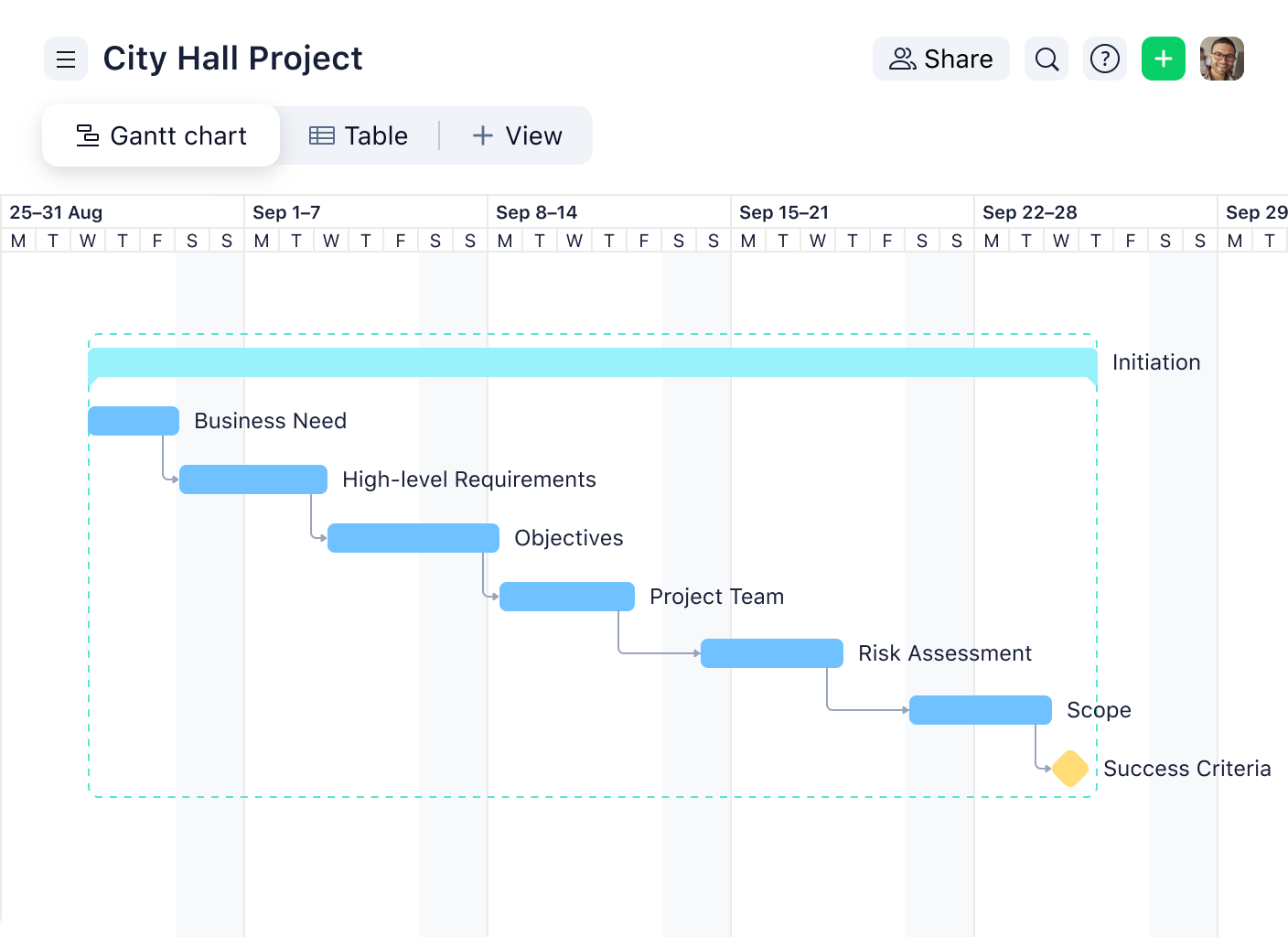
    A Gantt chart with the title “City Hall Project” and 7 horizontal bars with the terms “Business Need”, “High-level Requirements”, “Objectives”, “Project Team”, “Risk Assessment”, “Scope”, and “Success Criteria” listedA Gantt chart with the title “City Hall Project” and 7 horizontal bars with the terms “Business Need”, “High-level Requirements”, “Objectives”, “Project Team”, “Risk Assessment”, “Scope”, and “Success Criteria” listed

    A useful Gantt chart in project management usually includes:

    • Task list
    • Time scale
    • Task bars
    • Dependencies
    • Milestones
    • Progress indicators
    • Owners and resources

    Task list

    A structured list of tasks, subtasks, or work packages that make up the full scope of the project. This list often reflects the work breakdown structure (WBS) and may be grouped into phases, deliverables, or milestones. It forms the backbone of the Gantt chart because every visual element on the timeline corresponds to an item in this list.

    Time scale

    A horizontal calendar running along the top of the Gantt chart. It can display days, weeks, months, or even quarters depending on the length and complexity of your project. The time scale helps you quickly see how long tasks will take and how work stretches across the overall timeline.

    Task bars

    Horizontal bars that visually represent the planned duration of each task. The bar’s placement shows the start and end dates, while its length shows the expected amount of time needed to complete the work. Task bars make it easy to understand the project at a glance without digging into detailed schedules.

    Dependencies

    Arrows or connecting lines showing how tasks relate to each other. For example, one task might need to finish before another can begin (finish-to-start), or two tasks may need to run at the same time. Mapping dependencies helps you understand how delays can affect downstream work and is essential for accurate project planning.

    In modern tools such as Wrike, dependencies automatically adjust when timelines change, helping teams avoid cascading delays.

    Milestones

    Significant points in the project schedule, often marked by diamonds or distinctive symbols. Milestones represent major achievements such as approvals, phase completions, product launches, or client review dates. They act as anchors for measuring progress and ensuring the project stays aligned with critical deadlines.

    Progress indicators

    Visual cues showing how much work has been completed. These may include shaded portions of task bars, percentage-complete labels, or color changes. Progress indicators allow project managers and stakeholders to quickly compare planned timelines against actual performance.

    Owners and resources

    Labels, initials, or icons that identify who is responsible for each task, making accountability clear throughout the project. Some Gantt charts also include resource allocation details such as hours assigned or workload levels. This helps teams avoid overbooking individuals and ensures that tasks are distributed realistically across available resources.

    When to use a Gantt chart

    Gantt charts are especially helpful when:

    • Your project has many tasks, phases, or dependencies
    • You need to coordinate work across multiple teams or functions
    • Stakeholders want a clear visual of timelines and milestones
    • You must manage critical deadlines, such as product launches or campaign dates

    Examples include software releases, marketing campaigns, construction projects, event planning, and cross-functional initiatives. For small, simple efforts, a basic task list may be enough, but as complexity grows, a Gantt chart becomes much more useful. With software like Wrike, teams can scale Gantt charts from simple timelines to complex, cross-functional project plans as needs evolve.

    Who uses Gantt charts?

    Gantt charts are widely used across industries because they make it easier to plan work, manage dependencies, and keep teams aligned. Any team that needs clear timelines and structured project visibility can benefit from them, but they’re especially common in fields where scheduling and coordination are critical.

    Industries that rely heavily on Gantt charts include:

    • Construction and engineering: To sequence tasks, manage contractors, and track milestones for large builds
    • Software development: For mapping releases, tracking dependencies, and coordinating cross-functional teams
    • Marketing and creative teams: To plan campaigns, content calendars, and multi-phase deliverables
    • Manufacturing and product development: To manage production timelines, testing cycles, and launch plans
    • Event management: To coordinate vendors, deadlines, and logistics leading up to event day

    These charts help teams visualize how work moves from start to finish, making them useful for anything from small team projects to enterprise-level initiatives.

    Benefits of Gantt charts for project management

    Gantt charts bring structure, visibility, and predictability to project planning and execution. By laying out tasks across a timeline and showing how work connects, they help teams stay organized and avoid surprises. When supported by modern project management software such as Wrike, these benefits extend beyond planning into day-to-day execution. Key benefits include:

    • Clarity
    • Alignment
    • Risk visibility
    • Better coordination
    • Accountability

    Clarity

    A Gantt chart consolidates all tasks, dates, and milestones into one visual timeline. This makes it easy for teams and stakeholders to understand the project’s overall plan without digging through spreadsheets or documents.

    Alignment

    Because a Gantt chart shows who is responsible for which tasks and when those tasks are scheduled, everyone understands their role in the project. This reduces miscommunication and helps ensure all contributors are working toward the same goals.

    Risk visibility

    Dependencies help teams see where delays might impact other tasks. If one activity starts slipping, the Gantt chart makes it clear which downstream work may also be affected, giving project managers time to adjust before problems escalate.

    Better coordination

    With tasks assigned to individuals or teams along the timeline, Gantt charts simplify resource planning. Teams can spot bottlenecks, identify periods of overload, and adjust assignments to keep work moving smoothly.

    Accountability

    Each task bar shows who owns the work and when it must be completed. This transparency helps reinforce responsibility and keeps the team on track, especially on long or complex projects.

    How teams use Gantt charts in modern project environments

    Gantt charts have been a foundational project management tool for over a century, but today’s digital project environments have transformed how teams use them. 

    Modern work moves faster, involves more stakeholders, and often requires coordinating multiple tools or methodologies. Contemporary Gantt chart software adapts to these needs by offering capabilities that go far beyond basic timelines, including:

    • Real-time progress tracking
    • Automated scheduling updates
    • Resource load balancing
    • Collaboration tools and shared visibility
    • Integration with Agile or hybrid workflows

    Real-time progress tracking

    Modern Gantt charts update instantly as tasks are completed or adjusted. This helps teams spot delays early, understand how changes affect the broader schedule, and maintain an accurate project view without manual updates.

    Automated scheduling updates

    When one task shifts, connected dependencies automatically adjust. This reduces guesswork, eliminates outdated timelines, and prevents scheduling conflicts — all benefits that are especially useful in complex or multi-phase projects.

    Resource load balancing

    Contemporary tools allow project managers to see resource availability directly on the timeline. This helps prevent over-allocation, identify gaps, and ensure work is assigned realistically based on team capacity.

    Collaboration tools and shared visibility

    Where early Gantt charts were static, modern versions support comments, file attachments, and shared access. Cross-functional teams can communicate in context, track updates, and keep stakeholders aligned without the need for endless meetings or email threads.

    Integration with Agile or hybrid workflows

    Gantt charts are no longer just for traditional Waterfall projects. Many teams blend them with Agile methods, using timeline views alongside Kanban boards, sprint planning tools, and backlog management. This hybrid approach provides both flexibility and long-range visibility.

    Experience better project clarity with Wrike

    A well-built Gantt chart gives teams the structure, visibility, and confidence they need to deliver projects on time. With Wrike’s dynamic Gantt chart view, automated scheduling updates, real-time collaboration tools, and resource management features, you can move from static timelines to a truly connected project workflow. Whether you’re coordinating simple tasks or managing complex cross-team initiatives, Wrike makes planning clearer, execution smoother, and adaptability effortless.

    Start your free trial today and see how Wrike transforms Gantt charts into a powerful engine for project success.

    Gantt chart in project management FAQs

    The seven key elements of a Gantt chart are the task list, time scale, task bars, dependencies, milestones, progress indicators, and assigned owners or resources. Together, these components create a complete visual timeline that shows what needs to be done, when it will happen, and who is responsible for the work.

    A Gantt chart is used to plan, visualize, and track project schedules. It helps teams understand task durations, identify dependencies, monitor progress, and coordinate work across contributors. Project managers rely on Gantt charts to ensure that milestones are met and the overall project stays on track.

    To make a Gantt chart in Wrike, create a project, add your tasks, and assign start and end dates. Wrike automatically generates a dynamic timeline where you can adjust task bars, add dependencies by dragging connectors, convert tasks into milestones, and monitor real-time progress. Any task updates made in Wrike instantly sync across your Gantt chart, dashboards, and workload views.

    Advantages

    • Provide a clear visual timeline for the entire project
    • Highlight task dependencies and sequencing
    • Improve team alignment and shared understanding
    • Reveal scheduling risks and potential bottlenecks
    • Help track progress across phases or teams
    • Particularly useful for multi-phase or cross-functional projects

    Disadvantages (reduced with modern Gantt chart software)

    • Can be difficult to maintain for very large or complex projects
    • Static templates require frequent manual updates
    • Often lack real-time collaboration features
    • May become overwhelming when overloaded with details

    A strong Gantt chart tool should offer automated scheduling updates, task dependencies, milestone tracking, drag-and-drop editing, collaboration features, and real-time progress visibility. Integration with other project views — such as tables, boards, or workload management — is also essential. Platforms like Wrike combine these capabilities into a single, connected workspace.

    Gantt charts are primarily used in the project schedule section of a project management plan. This is where teams define task timelines, sequence work, identify dependencies, and map out the critical path. The schedule becomes the roadmap that guides execution, monitoring, and reporting throughout the project lifecycle.

    Lead time refers to the amount of time a successor task can begin before its predecessor task is fully complete. In a Gantt chart, lead time shortens the interval between dependent tasks, allowing parallel work and helping accelerate timelines when appropriate. It’s the opposite of lag time, which introduces delays between tasks.

    • Product
      • Product tour
      • Pricing
      • Templates
      • Apps & Integrations
      • Task Management
      • Gantt Charts
      • Wrike Status
      • Security
      • Wrike API
      • Compare
      • Features
    • Solutions
      • Enterprise
      • Marketing
      • Creative
      • Project Management
      • Product Development
      • Business Operations
      • Professional Services
      • IT Management
      • Students
      • All Teams
      • All Use Cases
    • Resources
      • Help Center
      • Community
      • Blog
      • Webinars
      • Interactive Training
      • Support Packages
      • Find a Reseller
      • Google Project Management Tools
      • CA Notice at Collection
    • Company
      • About Us
      • Leadership
      • Careers
      • Our Customers
      • Events
      • Newsroom
      • Partner Program
      • Collaborate - User Conference
      • Wrike Engineering
      • Contact Us
    • Guides
      • Project Management Guide
      • Professional Services Guide
      • Workflow Guide
      • Kanban Guide
      • Agile Guide
      • Scrum Guide
      • Marketing Project Management Guide
      • Collaborative Work Management Guide
      • Digital Marketing Guide
      • Go-to-Market Guide
      • Remote Work Guide
      • Return to Work Guide
      • Product Management Guide
      • Goal Setting Guide
    • Latest in Wrike Blog
      • 5 Gantt chart examples for project management
      • 21 best paid and free Gantt chart software tools for 2026
      • Life after Microsoft Project: Why Wrike is your future home for project management
      • 15 best enterprise collaboration software platforms (by use case)
      • Marketing campaign management: Templates, steps, and best practices
      • Gantt charts for multiple projects: How to manage them on one timeline
      • Enterprise project management software: 7 best tools in 2026

    Subscribe to Wrike news and updates

    Stay informed with the latest news and updates by subscribing to our marketing emails.

    AICPA logo.Footer icon BSI.Footer icon CSA star.

    Enterprise-Grade Security.
    Uptime Over 99.9%

    ©2006-2026 Wrike, Inc. All rights reserved. Patented. Privacy Policy. Terms of Service. Cookie Preferences. Your Privacy Choices

    Wrike logo