
Wrike logo.
    • For teams
      • Marketing

        Streamline proofing and reporting for seamless campaigns.

      • Creative & Design

        Create high-quality assets and get them approved in record time.

      • Product

        Accelerate your product process, from idea to delivery.

      • Client Services

        Exceed clients’ expectations with expert resources.

      • PMO

        Align strategy with execution and deliver results.

      • IT

        Execute initiatives, optimize workflows, and automate requests.

      • Operations

        Make work flow seamlessly with intuitive management tools.

      • HR

        Manage teams effortlessly with customizable HR features.

      • Legal

        Organize every file, case, and due date in one secure space.

      • Finance

        Centralize all financial tasks, from budgeting to invoicing.

      • See all teams

    • Workflows
      • Campaign Management

        Make marketing magic with end-to-end campaign management.

      • Agency Management

        Take full control of your agency management processes.

      • Client Service Delivery

        Get ahead of the competition with faster client services.

      • Product Lifecycle

        Watch your product lifecycle flow, from concept to customer.

      • Project Portfolio Management

        Manage your complete portfolio, from strategy to results.

      • Creative Production & Content

        Create, collaborate, proof, and approve all in one place.

      • Workflow Management

        Use custom statuses and automate your team workflows.

      • Project Management

        Plan Agile projects, track deadlines, and deliver results.

      • See all workflows

    • For industries
      • Technology

        Build solutions that matter, and deliver faster.

      • Manufacturing

        Enhance operations, accelerate production, and empower teams.

      • Professional Services

        Organize clients, streamline projects, and automate workflows.

      • Finance

        Deliver better, faster financials with automations.

      • Healthcare

        Collaborate cross-functionally in a secure setting.

      • Education

        Unite multiple disparate teams, departments, and colleges.

      • Construction

        Streamline building projects, from scoping to invoicing.

      • Media & Entertainment

        Choose one powerful platform for fast-paced work.

      • See all industries

    • Explore Wrike
      • Take a Product Tour

      • Book a Demo

      • ROI Calculator

      • Customer Stories

      • Start with Templates

    • Features
      • Dashboards

        Fuel better, faster, data-driven decisions with powerful analytics.

      • AI

        Learn about powerful AI and automations with Work Intelligence®.

      • Wrike Whiteboard

        Turn inspiration into execution with powerful visualization tools.

      • Gantt Charts

        Interactive project scheduling across teams.

      • Automation

        Define and trigger automated workflows to eliminate manual efforts.

      • Proofing

        Streamlined proofing and collaboration in one place.

      • Project Resource Planning

        Plan and allocate resources for timely delivery.

      • Project Views

        Get the full picture with customizable, intuitive project views.

      • Kanban Boards

        Instantly view project progress and create customized workflows.

      • Dynamic Request Forms

        Custom forms powered by conditional logic.

      • Approvals

        Keep approvers in the loop from start to finish.

      • Custom Item Types

        Tailor work items to fit your specific workplace.

      • See all features

    • Platform
      • Book a Demo

      • Start with Templates

      • Wrike AI

      • Integrations

      • Security

      • Mobile & Desktop Apps

    • Workflow-Powered Collaboration

      Sync with multiple teams to keep work flowing across your organization.

    • Industry-Leading Security

      We're dedicated to safeguarding data beyond industry standards and ensuring secure collaboration.

    • Pioneering AI and Innovation

      Put the power of data and AI to work for your organization.

    • Invested in Customer Success

      We support customers at every step of their journey from pre-sales to onboarding with 24/7 support.

    • Boundless Configuration

      Customize your workspace to suit the unique needs of every team in your organization.

    • Effortless Scalability

      Add new teams or adjust to rapid growth seamlessly with Wrike’s scalable platform.

    Need an extra team member?
    Build your own agent with Wrike and save 10 hours per week per project.
    Try AI agents
    • Go deeper
      • Resource Hub

        Top assets on productivity, collaboration, and more.

      • Wrike Blog

        Latest news and best practices on project management.

      • Educational Guides

        Guides and tools to unlock better work management.

      • Webinars

        Join our live or on-demand sessions to do your best work.

      • Customer Stories

        Explore Wrike’s case studies for key insights on customer success.

      • Developers

        Connect and build integrations with easy-to-use APIs.

    • Upskill and Connect
      • Training & Certifications

      • Help Center

      • Wrike's Community

      • Premium Support Packages

      • Wrike Professional Services

      • What's new

    Catch up on our most exciting product updates in 2025!
    2025 was another landmark year for Wrike, with some of our most exciting releases yet.
    Watch the video
  • Enterprise
  • Pricing
Contact Sales
  • Language selector dropdown with globe icon and list of available languages.
    English
    Dansk
    Deutsch
    Español
    Français
    Bahasa Indonesia
    Italiano
    Bahasa Melayu
    Nederlands
    Norsk
    Polski
    Português (BR)
    Svenska
    Русский
    日本語
    한국어
    中文 (简体)
    中文 (繁體)
Log in
Wrike logo.
Wrike logo.
  • Guide overview
    • Gantt Chart Basics
      • How to read a Gantt chart step by step
      • 1. Read the task list (vertical axis) first
      • 2. Orient yourself on the timeline (horizontal axis)
      • 3. Understand what the bars represent
      • 4. Check the fill or progress indicator
      • 5. Follow the arrows or lines between bars
      • 6. Look for diamonds on the timeline
      • 7. Find the critical path if it’s marked
      • 8. Check for a baseline
      • 9. Use the legend
      • Example: Reading a simple Gantt chart
      • Common mistakes to avoid
      • Put what you’ve learned to work
    • Project Management Basics
      • What are the project management basics?
      • What is a project?
      • What is project management?
      • What are the stages of project management?
      • Why is project management important?
      • What do project managers do?
      • Project manager certifications
      • Streamline your projects with Wrike
    • Project Management Charts
      • How to choose the right project management chart
      • The “pick in 30 seconds” checklist
      • 1. Gantt chart
      • 2. Kanban board
      • 3. Work breakdown structure
      • 4. PERT chart
      • 5. Critical path method (CPM)
      • 6. Milestone chart
      • 7. Burndown and burnup charts (for Agile teams)
      • 8. RACI chart
      • Common mistakes when using project management charts
      • Final thoughts
    • Project Management Methodologies
      • A. The traditional, sequential methodologies
      • B. The Agile family
      • C. The change management methodologies
      • D. The process-based methodologies
      • E. Other methodologies
      • F. The PMBOK “method”
    • Project Life Cycle
      • What is the project lifecycle?
      • The 5 phases of a project lifecycle
    • Best Project Management Software
      • Here’s a list of the project management software we review fully in this guide:
      • The best 15 project management software platforms in 2026
      • 1. Wrike: Best task management software for cross-functional collaboration
      • 2. Asana: Best task management software for attractive visuals
      • 3. Monday.com: Best task management software for use case templates
      • 4. Adobe Workfront: Best task management software for Adobe integration
      • 5. Smartsheet: Best task management software for spreadsheet-style functionality
      • 6. ClickUp: Best task management software for mind mapping
      • 7. Airtable: Best task management software for data-centric teams
      • 8. Jira: Best task management software for development teams
      • 9. Trello: Best task management software for simple projects
      • 10. Notion: Best task management software for document storage
      • 11. Hive: Best task management software for user-led feedback
      • 12. Zoho Projects: Best task management software for the real estate industry
      • 13. Teamwork: Best task management software for teams looking to get started quickly
      • 14. Basecamp: Best task management software for small businesses and teams
      • 15. GanttPro: Best task management software for specialist Gantt charts
      • 10 additional PM software options
      • 1. MeisterTask
      • 2. Microsoft Project 
      • 3. ProWorkflow
      • 4. TeamGantt
      • 5. Accelo
      • 6. ProjectManager
      • 7. Planview AdaptiveWork
      • 8. Scoro
      • 9. Confluence
      • 10. LiquidPlanner
      • Choose Wrike for customizable and truly scalable project management software
      • FAQs
    • Team Collaboration Tips
      • Effective project collaboration tips for teams
      • The importance of collaboration in project management
      • How to set up a project team
      • What makes a successful project team
      • How to make the project kickoff meeting a success
      • Tips for effective team management
      • How to create a collaborative work environment
      • Project management collaboration tips and techniques
      • Tips for remote collaboration and virtual meetings
    • Agile Basics
    • Agile Project Management Tools
      • What are Agile project management tools?
      • How we evaluate and choose the top tools
      • The best Agile project management tools comparison chart
      • What are the 11 best Agile project management tools?
      • 1. Wrike
      • 2. Asana
      • 3. Monday.com
      • 4. ClickUp
      • 5. Smartsheet
      • 6. Adobe Workfront
      • 7. Jira [Atlassian] Work Management 
      • 8. Microsoft Project
      • 9. Teamwork
      • 10. Zoho Sprints
      • 11. ProofHub
      • How to pick the best Agile project management tool
      • Features to look for in Agile project management tools
      • Benefits of using Agile project management tools
      • Collaboration-boosting effects of Agile project management
      • How can an Agile project management tool help your company?
      • FAQs
      • Is Agile a project management tool?
      • How do Agile project management tools support software development teams?
      • Can Agile project management tools be customized for different project needs?
      • What are Agile methodologies, and how do they benefit Agile teams?
      • How do Agile tools improve collaboration in teams?
    • Project Management Frameworks
      • A. What is a project management framework?
      • B. What do Agile frameworks have in common?
      • C. The Scrum framework
      • D. Other popular Agile project management methods
      • Is Lean project management an Agile framework?
      • E. Agile epics defined
      • F. Project manager best practices for choosing the right framework
      • G. Free Agile project management tools
    • Resources
      • Project management training
      • Project management books
      • Leadership inspiration
    • Glossary
    • FAQ
      • Advanced Terminology
      • Agile Project Management
      • Basic Terminology
      • Methodologies
      • PM Software Features
      • PMI
      • Professional Development
      • Tools
    1. Home
    2. Project Management Guide

    Gantt chart basics: How to read a Gantt chart in 9 easy steps

    6 min readLAST UPDATED ON MAR 19, 2026
    Artem Gurnov
    Artem Gurnov Director of Account Development, Wrike
    See Wrike for PMO

    Let’s say you open a project plan and you see horizontal bars stretching across a calendar, color-coded rows, dotted lines connecting tasks, and diamond shapes scattered throughout. If you don’t already know what you’re looking at, it might seem incredibly confusing.

    This Gantt chart guide walks you through how to read each symbol and sign (without needing a project management degree).

    By the end, you’ll know what each task bar, dependency line, and milestone symbol actually means, what to check when you first open a new chart, and how to tell whether a project is on track without asking anyone to explain it to you. Whether you’re staring at a simple Gantt chart for a three-task sprint or a complex project spanning multiple teams and phases, we can help.

    Want a Gantt chart tool that’s easy to read from day one?

    How to read a Gantt chart step by step

    Reading a Gantt chart gets easier once you have a consistent sequence. Follow these steps every time you open one, whether it’s a visual timeline for a construction project, a software development sprint, or a company-wide initiative.
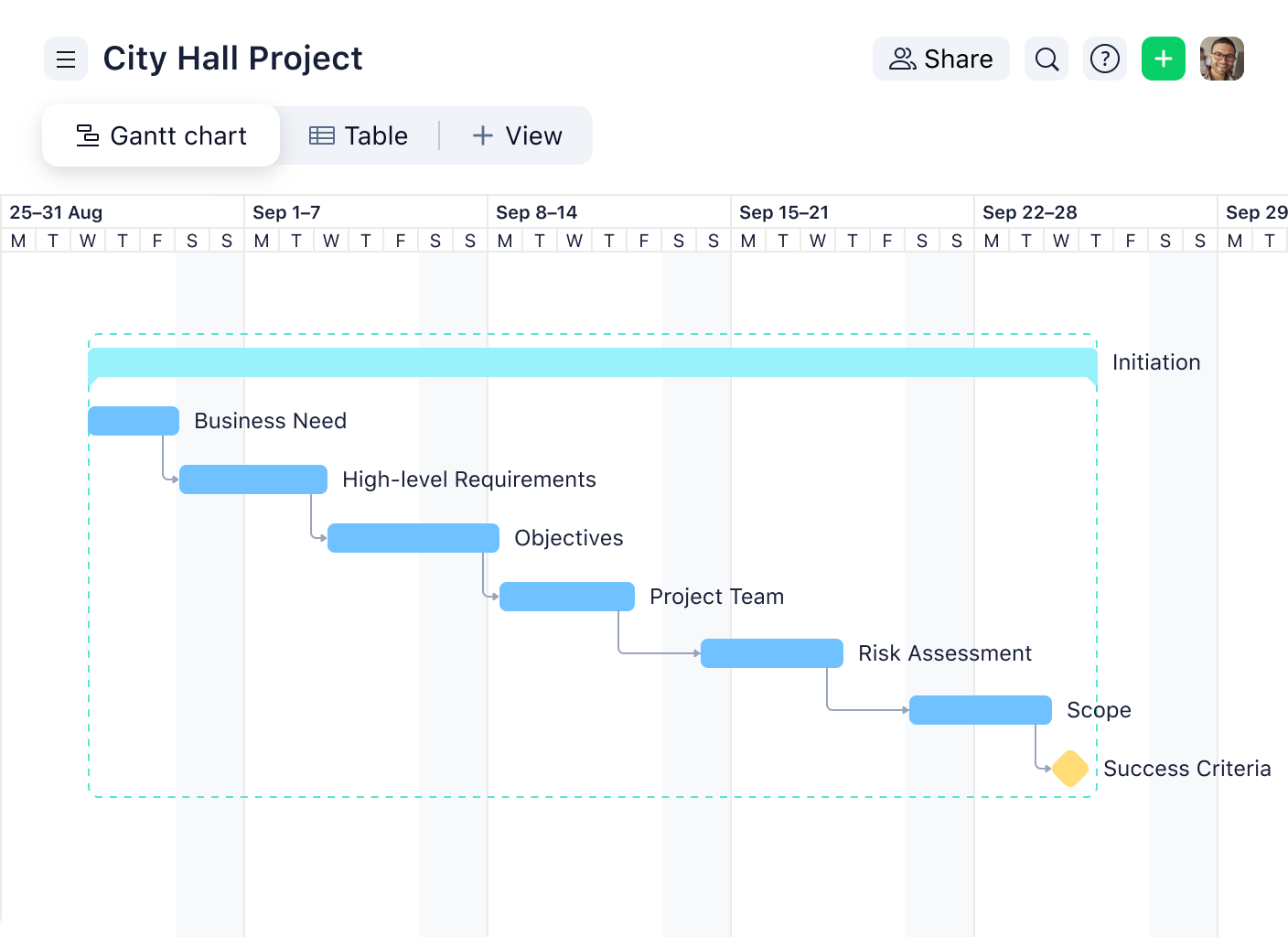
    A Gantt chart with the title “City Hall Project” and 7 horizontal bars with the terms “Business Need”, “High-level Requirements”, “Objectives”, “Project Team”, “Risk Assessment”, “Scope”, and “Success Criteria” listedA Gantt chart with the title “City Hall Project” and 7 horizontal bars with the terms “Business Need”, “High-level Requirements”, “Objectives”, “Project Team”, “Risk Assessment”, “Scope”, and “Success Criteria” listed

    1. Read the task list (vertical axis) first

    The left-hand column is your task list, the spine of the entire project. Each row represents a task or a group of related tasks. Read top to bottom to understand the project scope and structure before you even glance at the timeline. Jumping straight to the bars is the number one reading mistake most people make.

    2. Orient yourself on the timeline (horizontal axis)

    Wrike interface displaying Gantt chart and task table for creative team projects.Wrike interface displaying Gantt chart and task table for creative team projects.

    The horizontal axis running along the top is your project schedule laid out as a calendar, measured in days, weeks, or months, depending on the project’s scale. Find today’s date (the red vertical line in the example above). 

    Everything to the left has started or finished. Everything to the right is upcoming. This single step reframes everything else you’re about to read.

    3. Understand what the bars represent

    Each bar maps directly to a task on the vertical axis. The bar’s left edge is the start date, the right edge is the end date, and the length tells you the task duration. A longer bar means a longer task, not a harder one, nor a more important one. Just longer.
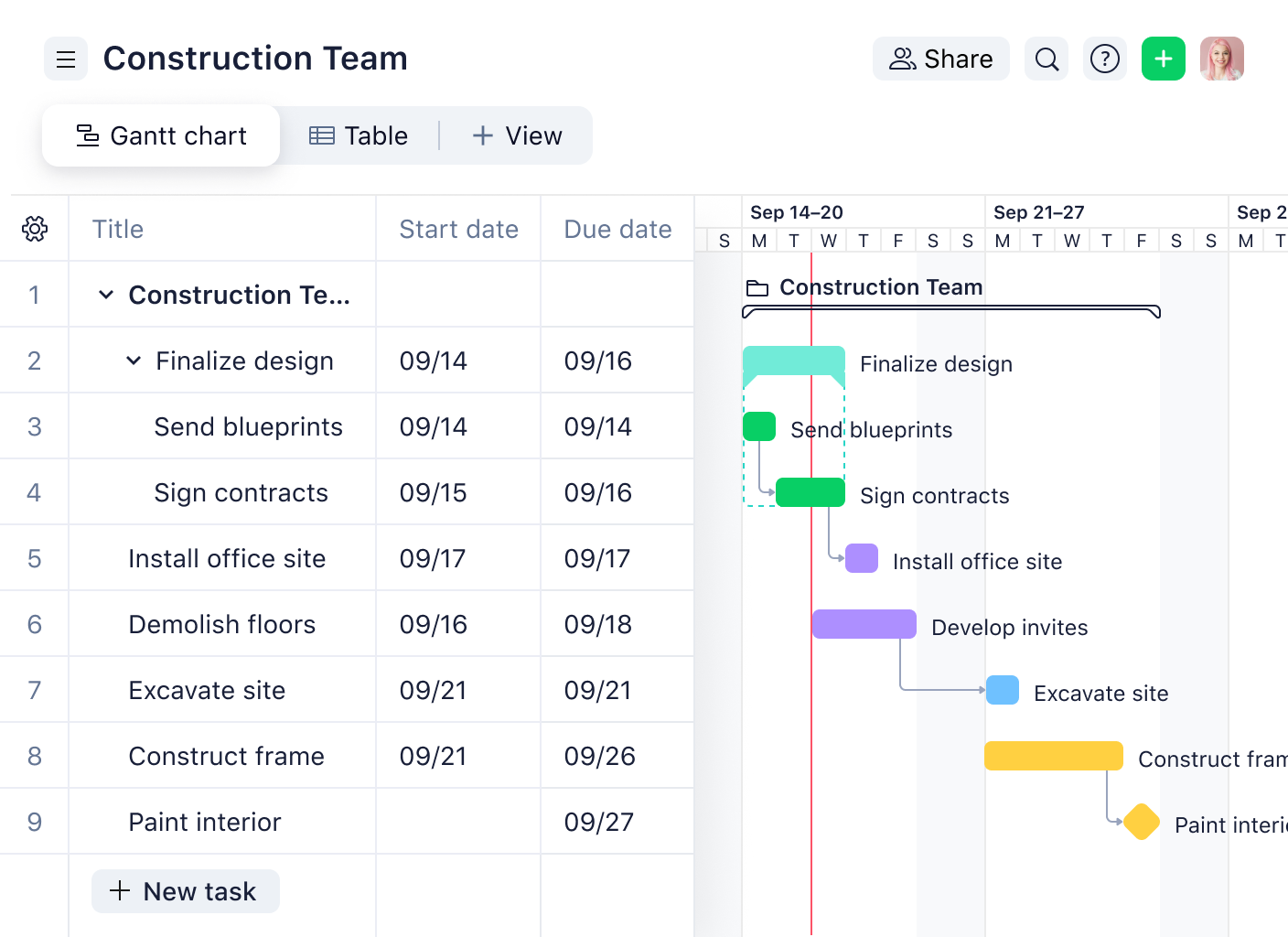
    Wrike Gantt chart and task table showing construction team project timelines.Wrike Gantt chart and task table showing construction team project timelines.

    Let’s look at the example above for a construction project. Demolishing the floors (in purple) is going to take longer than excavating the site (blue), but that doesn’t mean excavating the site is easier; it only means the floor demo will take longer to complete. 

    4. Check the fill or progress indicator

    Some Gantt chart software shows a darker fill or inner bar running inside the main bar to reflect task progress. If a bar is 75% filled and today’s date lines up with the 75% mark on the horizontal axis, that task is on schedule. If today is past that point and the fill hasn’t caught up, something’s slipping.

    5. Follow the arrows or lines between bars

    These are task dependencies, and they’re where schedule risk actually lives. An arrow from task A to task B means task B can’t start until task A is done. A delay in one dependent task affects everything downstream. Trace the dependency lines before you draw any conclusions about overall project progress.
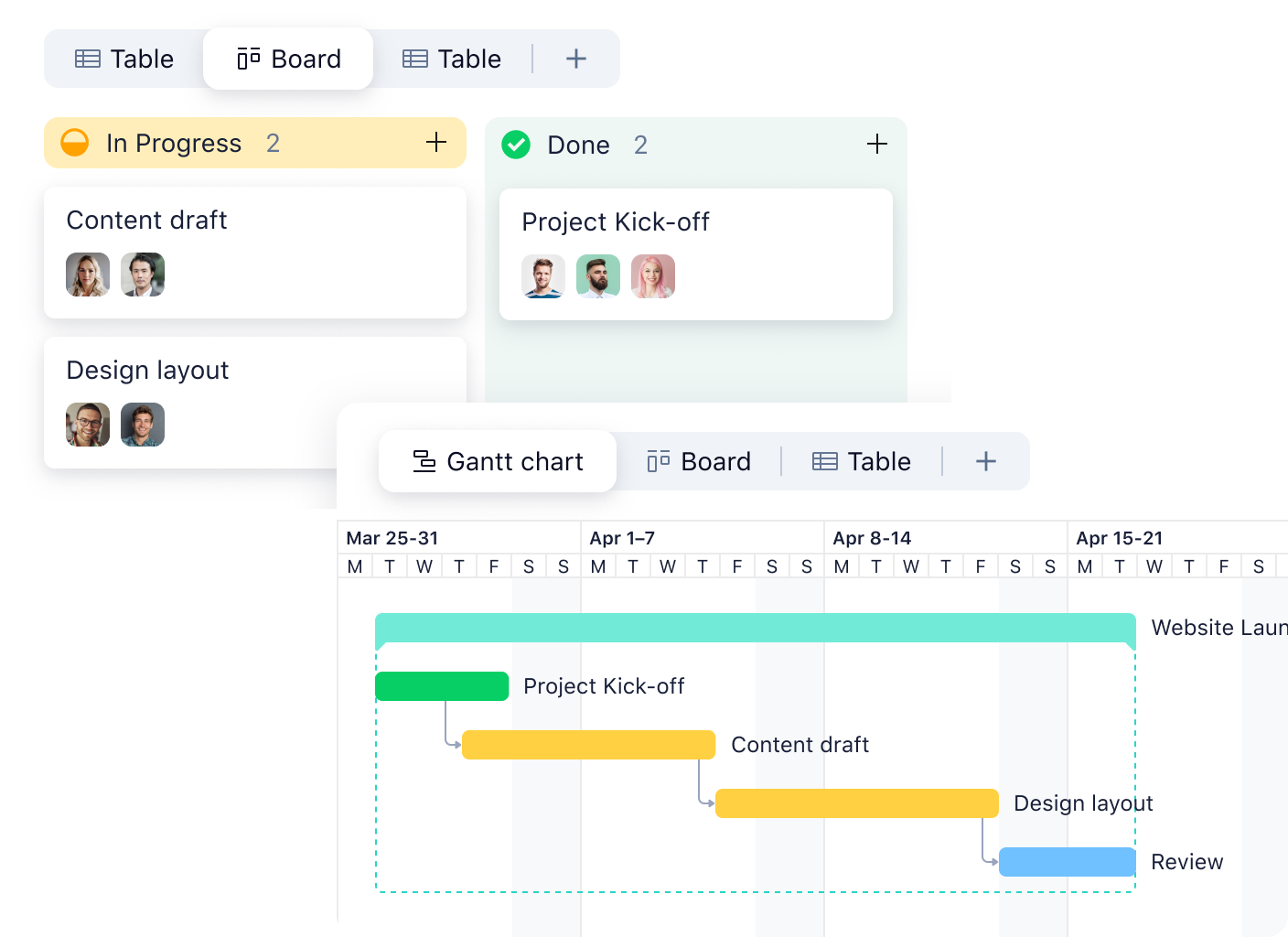
    Wrike board and Gantt views displaying project tasks in columns and timeline.Wrike board and Gantt views displaying project tasks in columns and timeline.

    If you look at the example above, we can see the design layout can’t start until after the content draft is complete. The arrows between the two tasks indicate that the design layout is dependent on the content draft finishing first. 

    6. Look for diamonds on the timeline

    Diamonds mark milestones, which are fixed points on the horizontal axis that represent key dates, deliverables, or decisions. They have no duration and don’t stretch across the timeline. They sit at a single point and signal that something important happens here.

    7. Find the critical path if it’s marked

    Some Gantt chart tools highlight the critical path, which is the sequence of tasks where any delay pushes the project completion date. If a task sits on the critical path and it’s behind, that’s your priority — everything else has some float. 

    8. Check for a baseline

    A baseline appears as a secondary bar running alongside the main one on the horizontal axis. It represents the original project plan, with the start and end dates as agreed before work began. Comparing it to the current bar shows whether the project has drifted and by how much.

    9. Use the legend

    Read this before drawing conclusions from colors. What’s red in one team’s Gantt chart might mean “on hold” while in another it means “high priority.” Never assume. Check the legend first.

    Example: Reading a simple Gantt chart

    A Gantt chart with the title “City Hall Project” and 7 horizontal bars with the terms “Business Need”, “High-level Requirements”, “Objectives”, “Project Team”, “Risk Assessment”, “Scope”, and “Success Criteria” listedA Gantt chart with the title “City Hall Project” and 7 horizontal bars with the terms “Business Need”, “High-level Requirements”, “Objectives”, “Project Team”, “Risk Assessment”, “Scope”, and “Success Criteria” listed

    Take the “City Hall Project” above. It’s running from late August through late September.

    Start with the vertical axis: The task list runs top to bottom: Business Need, High-level Requirements, Objectives, Project Team, Risk Assessment, Scope, and Success Criteria. The sequence tells you the story before you look at the timeline.

    Check the horizontal axis: The timeline runs in weekly bands from August 25 through late September. Each task bar sits inside that calendar, so you can immediately see when work starts and how long it runs.

    Follow the dependency arrows: Every task is connected by a finish-to-start arrow. If Business Need had slipped by three days, every task below it would have shifted right by three days too.

    Spot the milestone: Success Criteria is marked with a gold diamond, not a bar. It’s the fixed endpoint of the Initiation phase, the moment everything above it has to be completed before the project moves forward.

    Common mistakes to avoid

    You can follow every step above and still walk away with the wrong picture. Gantt charts are intuitive once you know the rules, but a few assumptions trip up even experienced project managers. Here’s where most people go wrong.

    Assuming a long bar means an important task: Bar length reflects duration, not priority. When you use a Gantt chart to plan projects, a two-week bar might be a low-effort waiting period, while a one-day bar might be the most critical handoff in the project.

    Reading left-to-right without anchoring to today: Without finding the current date first, you can’t distinguish what’s late from what’s future. This is especially easy to miss in online Gantt chart software, where the default view might not center on today’s date.

    Ignoring task dependencies: In complex projects with lots of dependent tasks, a task that looks fine on its own might be blocking five others. Always follow the arrows before drawing conclusions.

    Treating percentage complete as time complete: A task marked 50% done means half the work is done, not that half the time has elapsed. Actual progress and elapsed time diverge constantly, especially in software development and creative projects.

    Confusing summary bars with individual tasks: Summary tasks group related work and appear as larger capped bars spanning multiple rows. They’re containers, not single pieces of work, so don’t assign a project phase status based on the summary bar alone.

    Skipping resource allocation columns: Some Gantt chart software includes resource or task-owner columns. A bar that’s behind might simply mean the task owner is overloaded elsewhere, which might require a major resourcing shift.

    Put what you’ve learned to work

    A Gantt chart is only useful if you can read it quickly and trust what it's showing you. That comes down to two things: knowing the elements (which you now do), and using a tool that doesn’t make you fight to see them.

    Wrike's Gantt chart view keeps dependencies, milestones, and task progress visible without digging. You can drag to reschedule tasks, see how a change ripples through the timeline, and share a live view with your team instead of exporting a static file that’s outdated an hour later.

    If your current setup requires a meeting to explain what the chart is telling you, that’s a problem worth fixing.

    Check out our Gantt charts

    FAQs

    Find today’s date on the horizontal axis and check whether the progress fill inside each active task bar has kept pace with it. If the fill is behind where today falls on the bar, that task is running late.

    It tells you the planned task duration. A longer bar means the task takes more time, not that it’s more important or complex.

    They show task dependencies, meaning one task must finish before the next can begin. A delay in an upstream task automatically pushes back every dependent task connected to it.

    Look for a sequence of tasks highlighted in a distinct color, usually red. Any delay on the critical path extends the project’s end date, so these tasks get priority over everything else.

    A baseline is a snapshot of the original project plan, shown as a secondary bar alongside the current one. Comparing the two tells you how far the project has drifted from what was initially agreed.

    Focus on structure first: task names, bar lengths, dependency arrows, and progress fills will tell you most of what you need. For color meaning, look for patterns or ask the chart’s owner directly, since color conventions vary across Gantt chart tools and teams.

    Basic Project Management
    • Project Charter
    • Project Management Stakeholders
    • What is a Project?
    • Work Breakdown Structure
    • Project Objectives
    • Project Baseline
    • Project Management Scheduling
    • Project Management Work Packages
    • Project Management Scope
    • Scope Creep
    Advanced Project Management
    • What is PERT?
    • S-Curve
    • Network Diagram
    • SMART
    • Risk Management
    • Cost Estimation
    • Feasibility Study
    • Monte Carlo Analysis
    • Project Integration
    • Cost Management
    PMI
    • Milestones
    • PDU
    • PMI Project Management
    • What To Do With Certification
    • Certification
    • Become Certified
    • PMP Certification
    • Best Certification
    Software Features
    • Critical Success Factors
    • Capacity Planning
    • User Role Access Permissions
    • Time Tracking
    • Budget Tracking
    • Request Forms
    • Work Assignments
    • Version Control
    • Dependency Managements
    • Project management Milestones
    Tools
    • Project Management Software
    • Project Management Tools
    • Project Management System
    • Gantt Charts
    • Product
      • Product tour
      • Pricing
      • Wrike AI
      • Templates
      • Apps & Integrations
      • Task Management
      • Gantt Charts
      • Security
      • Wrike API
      • Compare
      • Features
    • Solutions
      • Enterprise
      • Marketing
      • Creative
      • Project Management
      • Product Development
      • Business Operations
      • Professional Services
      • IT Management
      • Students
      • All Teams
      • All Use Cases
    • Resources
      • Help Center
      • Community
      • Blog
      • Webinars
      • Interactive Training
      • Support Packages
      • Wrike Status
      • Find a Reseller
      • Google Project Management Tools
      • CA Notice at Collection
    • Company
      • About Us
      • Leadership
      • Careers
      • Our Customers
      • Events
      • Newsroom
      • Partner Program
      • Collaborate - User Conference
      • Wrike Engineering
      • Contact Us
    • Guides
      • Project Management Guide
      • Professional Services Guide
      • Workflow Guide
      • Kanban Guide
      • Agile Guide
      • Scrum Guide
      • Marketing Project Management Guide
      • Collaborative Work Management Guide
      • Digital Marketing Guide
      • Go-to-Market Guide
      • Remote Work Guide
      • Return to Work Guide
      • Product Management Guide
      • Goal Setting Guide

    Subscribe to Wrike news and updates

    Stay informed with the latest news and updates by subscribing to our marketing emails.
    Logo AICPALogo BSILogo CSA STAR

    Enterprise-Grade Security.
    Uptime Over 99.9%

    ©2006-2026 Wrike, Inc. All rights reserved. Patented. Privacy Policy. Terms of Service. Your Privacy Choices

    Wrike logo