What Is a Milestone in Project Management?

What is a Milestone in Project Management?
Milestones are fundamental markers that signify major accomplishments, pivotal events, or the completion of key deliverables within a project’s timeline. As a project manager, you need to understand milestones and how to use them to track performance.
This article aims to provide a comprehensive understanding of project milestones, including their definition and some key examples.
Want to skip the theory and get started right now? Unlock your free Wrike trial to create, track, and communicate your project milestones — all in one place.
Milestone definition
A milestone is a specific point within a project’s life cycle used to measure the progress toward the ultimate goal. Milestones in project management are used as signal posts for a project's start or end date, external reviews or input, budget checks, submission of a major deliverable, etc. A milestone is a reference point that marks a significant event or a branching decision point within a project.

Examples of project milestones
While the final deliverable or product is indeed a significant milestone, there are several other milestones that will help you move smoothly toward the final goal. An example of a milestone in project management could be any of the following:
- The beginning and end dates for project phases
- Getting approval from a stakeholder that allows you to move to the next phase
- Key deliverables, meetings, or events
Milestones break projects into phases
A good example of a milestone in project management is the launch of a product. Different phases can be broken up by critical events, like getting final design approval for the product or the product arriving at the warehouse for shipping. Project management milestones should mark the four phases in the project life cycle: initiation, planning, implementation, and closure.


One project milestone might be as simple as placing the final product order or signing off on the cover artwork for a magazine launch.
How to visualize project milestones
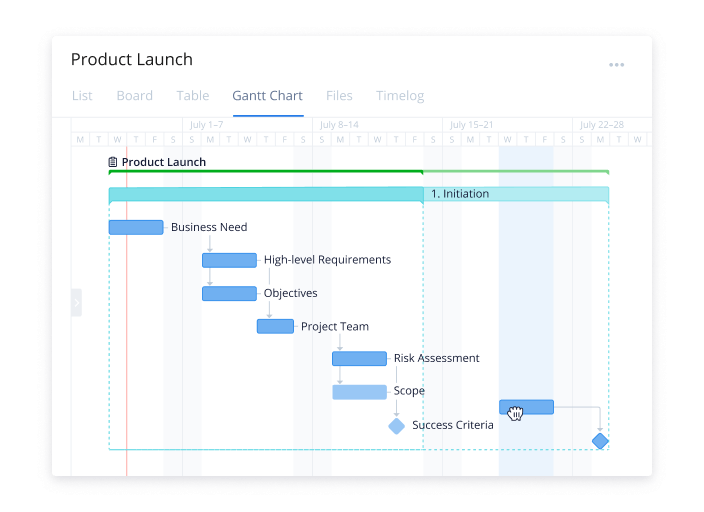
You might be wondering how to visualize project milestones, which can be tricky if they aren’t necessarily deadline-driven. One of the easiest ways to visualize project milestones is with a Gantt chart, which shows the outstanding milestones and the tasks that might be holding them up.
How to share milestones with project stakeholders
It’s much easier to make progress on a project if your stakeholders know about each milestone. So how can you share milestones with project stakeholders? Using Wrike, you can assign stakeholders to the milestone task so the event will appear on their dashboard.
Wrike even offers a built-in conflicts monitor to identify potential scheduling conflicts so your team can avoid bottlenecks and make it to project completion smoothly.
Manage milestones with Wrike
Wrike is the ideal solution for managing project milestones. With its user-friendly interface and project tracking features such as dashboards and Gantt charts, Wrike empowers project managers to effectively create, and monitor milestones, fostering a strong sense of transparency with your team.
A milestone in project management is a significant point within a project’s life cycle used to track progress toward the final goal. It marks key events such as phase completions, stakeholder approvals, or major deliverables. Milestones help break projects into manageable phases, guide decision-making, and keep stakeholders informed of critical achievements.
A PDU, or Professional Development Unit, is a measure of ongoing learning and development in project management. Project Management Professionals (PMPs) must earn 60 PDUs over three years to maintain their certification, which can be achieved through courses, seminars, webinars, self-directed learning, or volunteering. PDUs ensure that project managers continue to grow their skills and stay current with industry practices.
PMI, the Project Management Institute, is a global nonprofit that sets project management standards and offers certifications, including the PMP credential. Founded in 1969, it publishes the PMBOK Guide detailing best practices and methodologies. PMI membership and certification provide project managers with resources, training, and a professional network to support career growth and ongoing development.
The PMP (Project Management Professional) certification, offered by PMI, is a globally recognized credential that validates expertise and experience in project management. Aligned with the PMBOK Guide, it demonstrates the ability to lead and manage projects effectively. PMP holders must earn continuing Professional Development Units (PDUs) and renew the certification every three years.