What Are High-Level Requirements in Project Management?

What Are High-Level Requirements in Project Management?

Project management requires a great deal of planning and documentation upfront. Usually found in the project charter, high-level requirements in project management reflect the need for a broad, bird’s eye view of the work and features that must be completed over the course of the project.
What is a requirement in project management?
In project management, requirements give a broad rundown of the tasks and conditions that need to be met in order for the project to be successful.
There are different types of requirements to consider — including technical and business requirements. Business requirements should articulate what the organization expects to do as a result of the project. Meanwhile, technical requirements may indicate specific features or customer functionalities.
What are high-level requirements in project management?
Unlike a detailed project plan, high-level requirements emphasize the “what” of the project rather than the “how.” This means that a high-level requirements list will not give granular details about each phase of the project and each team member’s duties. Instead, it is documentation that should be easily accessible and simple for stakeholders to understand.
It’s important to note that high-level requirements and objectives are not the same. While objectives map the road to project success through milestones and achievements, requirements outline broad features and conditions for project success.
Why are high-level requirements important?
High-level requirements are key to stakeholder management and engagement. Keeping your requirements simple and easy-to-digest allows stakeholders and project teams to absorb the crucial information about the project’s expected outcomes.
According to the Project Management Institute, 47% of unsuccessful projects fail to meet goals due to poor requirements management.
High-level requirements template and examples
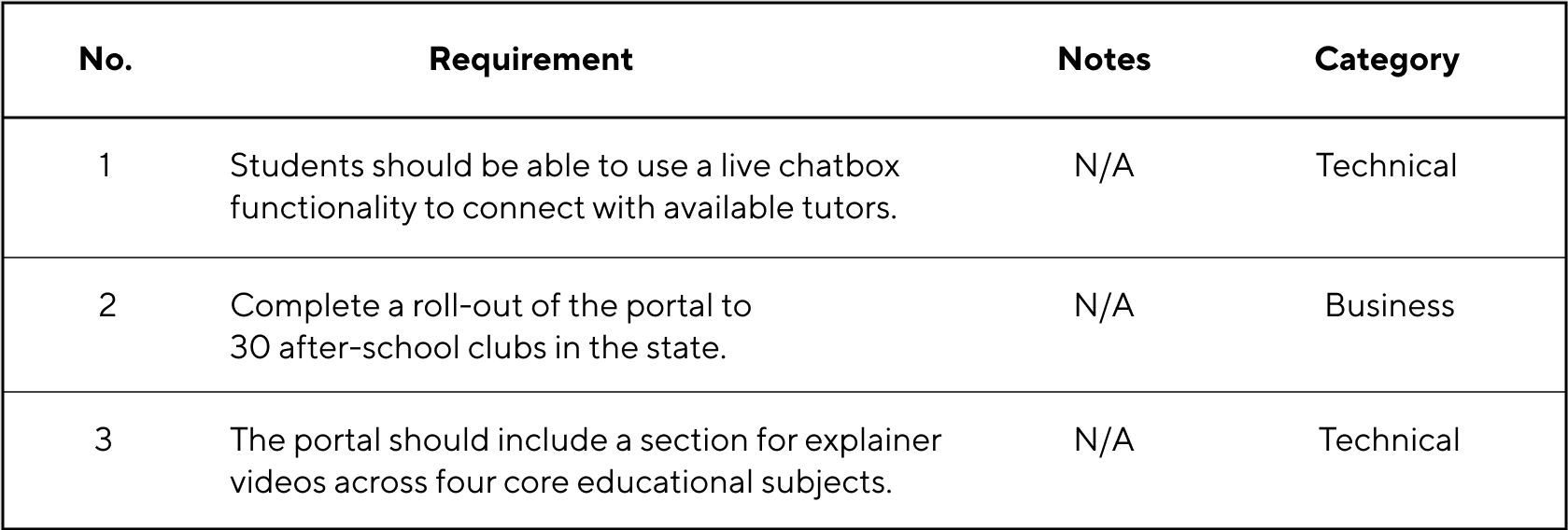
In the below high-level requirements example, a tutoring company has decided to create a portal to help students manage their assignments. The high-level requirements below reflect the conditions that should be satisfied.

Note that these high-level requirements are not overly detailed or too complex. They don’t dive into the minutia of day-to-day tasks or even indicate which teams will be responsible for executing these requirements. Instead, they give an overview of the work and features to be completed.
In project management, deliverables are tangible outputs produced through objective-focused work within a project’s scope. They can be internal or external and are usually due on specific dates. Unlike objectives or milestones, deliverables are concrete items that must be completed and handed over to advance or close a project.
Governance in project management is the framework that defines accountability, decision-making authority, and reporting relationships within a project. It establishes who oversees the project, who makes key decisions, and how information flows between stakeholders. Effective governance provides structure, oversight, and alignment, with the project sponsor playing a critical coordinating role.
PMBOK, or the Project Management Body of Knowledge, is a comprehensive framework of standardized processes, best practices, terminology, and guidelines for project management. Maintained by the Project Management Institute (PMI), it helps organizations standardize and tailor their project practices while reducing the risk of failure.
A PMO, or project management office, is a centralized team or function that standardizes project management processes across an organization. It provides governance, best practices, tools, and oversight to improve efficiency and consistency. By aligning projects with business objectives, a PMO helps organizations deliver initiatives on time, within budget, and with greater strategic impact.
A project in project management is a temporary effort made up of specific tasks designed to achieve a clearly defined goal or outcome. It can be simple or highly complex, and responsibilities are usually assigned by a manager who outlines expectations and deadlines. Teams often break projects into smaller tasks to improve accountability, streamline workflow, and ensure timely completion.