Manage support tickets through a customized form and monitor their resolution from incoming to resolved. Review team progress through dashboards and custom reports.
Prevent support requests from falling through the cracks
Support requests can come at you from all directions. It’s critical to capture all of those requests in one place while still being able to prioritize them, so your team can address them efficiently. This ticketing system template makes use of some of Wrike’s most powerful features, so you can provide timely support. Request forms can help you manage incoming requests and ensure all relevant details are included, enabling your help desk team can begin addressing the issue as soon as possible. Custom dashboards can help you organize all your customer support interactions in one place, allowing you to provide efficient support. Lastly, custom reports can help your team report on progress, demonstrate their value, and set measurable goals.
Why you need this template
Support requests come in from multiple sources
Use Wrike’s Custom Request Forms to make sure that all incoming help tickets can be properly assigned, managed, and tracked. Review overall progress with dashboards and reports.
Incoming tickets lack the necessary information
Create a request form in Wrike that has fields for all the relevant information you need to address the issue. With a custom and dynamic request form, you collect all necessary details up front and can even auto-assign projects to the appropriate team member based on the type of issue.
Progress is hard to measure
Wrike’s Dashboards make it easy to get an overview and see what each team member is working on at any given time.
This template provides a sample request form with basic fields. The form can be accessed by users in your account from the green + button at the top of the workspace. Share the form with anyone (even if they're not in your Wrike account) by creating an external link. Once the form is filled out and submitted, a new task will appear in your Ticketing & Helpdesk project.
The Ticketing & Helpdesk template contains three sample subfolders for categorizing incoming tickets: IT, Product, and Service. All new issues land in the parent folder as tasks and can later be tagged into subfolders.
Go to the List view to see task details or double-click tasks in other views to access their details.
Use the + next to a task's status to select an assignee. If that person is not a Wrike user, invite them by entering their email. The task is assigned as soon as they join.
This template contains sample tasks and folders for context. You can rename, remove, or add sections to the folder structure at any time.
By default, everything in the shared folder is visible to all regular users in your account. If a task isn't shared, assign it to someone to automatically share the task with them.
Work on Tasks and Review Progress
Switch between subfolders to review progress for each ticket category, or use one of Wrike's work views to view the same set of tasks from a different perspective. The Board view is the default view for subfolders in this template. It shows tasks organized in columns by status. Use the Board view to:
See what tasks you need to work on
Track task status
Change task status by dragging and dropping tasks from one column to another
Create new tasks
Depending on your process complexity, you may want to use a different work view (List, Table, Timeline, etc). To switch the default view:
Right-click the Ticketing & Helpdesk project.
Hover over Set default view.
Select the appropriate view.
This template also includes a sample dashboard and report. Find relevant tabs in the monitoring panel at the top of your workspace for a customizable overview of ongoing or completed work.
FAQ
Anyone can use the ticketing and helpdesk template. However, teams that primarily work in a support function within their organization have the most to gain from this template. IT teams, for example, can use forms to manage requests from other departments, then use the dashboard to group them out into categories like “incoming”, “open”, “pending”, and “solved”.
With the ticketing and helpdesk template, you can track incoming requests from specific users. Use the template to keep track of the status of a ticket — from “open” to “resolution”. Also, track who is responsible for each ticket and build accountability into your everyday workflows.
Sending a request to your IT department’s helpdesk is easy. However, these requests are often lost in email inboxes or lack clarity in explaining the problem that needs to be solved. This template solves ticketing problems like confusing or hard to track requests and uncertainty around ticket status.
Check out the video above to learn more about how to set up and make the most of your new template.
Harness the power of Agile, an iteration-based approach to development. This Wrike template helps you prioritize a backlog for planning, manage sprints with boards, and track progress using reports.
Project management
Project Scheduling
A project template for classic, timeline-driven project management.
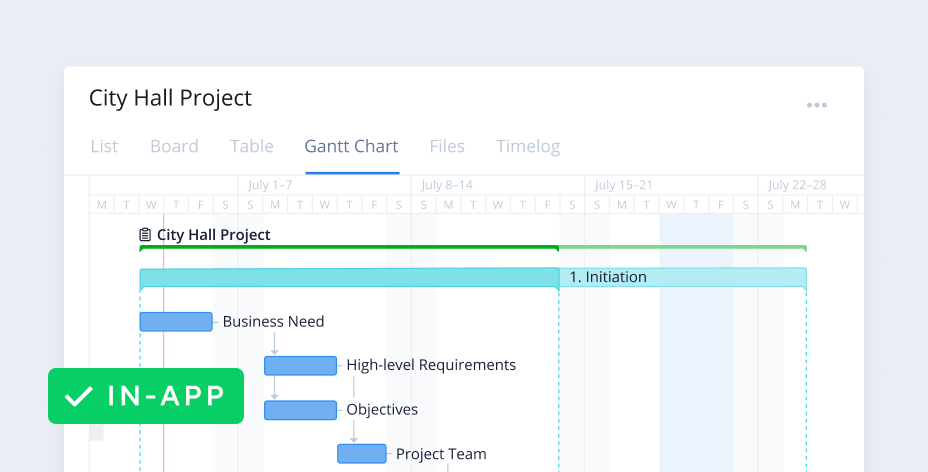
Split projects into actionable items, assign due dates, and track progress on a Gantt chart.
Project management
Complex Project With Phases
An effective, phased approach to project management. This template breaks complex projects down into manageable phases, allowing you to assign due dates to tasks and track progress on a visual timeline.
Agile teams
Kanban Project
Practice Kanban-style project management with Wrike. Visually manage your project with boards, limit the amount of work in progress, focus on the flow, and improve your process as you go.
Agile teams
Agile Teamwork
Harness the power of Agile, an iteration-based approach to development. This Wrike template helps you prioritize a backlog for planning, manage sprints with boards, and track progress using reports.
Project management
Project Scheduling
A project template for classic, timeline-driven project management.
Split projects into actionable items, assign due dates, and track progress on a Gantt chart.
Ticketing and Help Desk resources
Case Study
Discover how Wrike brought irreplaceable efficiency to Fitbit’s launch process.
eBook
Introducing the Wrike Way, a model for helping organizations collaborate more effectively and build a culture of excellence.
How to install this template in your account
You can only access this template when you create a new space. You can access the use case templates gallery through the space creation wizard. When you opt to create a new space, the template gallery opens by default.
Click the “+” button in the upper-right corner of your workspace.
Select “Space.”
On the page that opens, hover over the use case you want and click “Preview.” Look for the “Service Desk” template in the list (use the search bar if needed).
Now, you can see more information about the use case. Click “Select” to create a space.
Yes, there are.
To use this template, you need to have at least the Business plan or up. Check our plans here.
You must have the required permission to create a public space in your account.
If the template contains account-level custom fields, custom item types, workflows, request forms, or automation, you must have the permission required to create those items.
This template is only available when the workspace language is set to English.
Check the prerequisites above. If you don’t match one of the prerequisites, talk to your space admin or your account owner. If you match all the prerequisites and you still can’t see the “Service Desk“ template, feel free to reach out to the Wrike support team.
Unlock the power of Wrike’s templates
Use our smart search tool to explore versatile templates, designed for easy customization and streamlined project management.
Wrike enhances its website search experience using Google's Vertex AI Search and Conversation generative AI service. Users are cautioned that generative AI might produce inappropriate, inaccurate, offensive, or unintended results, and are advised against submitting explicit, harmful, offensive, or illegal content as search input. Neither Wrike nor Google uses your search inputs to train its machine learning models or for advertising purposes, but search activities may be collected and/or stored via cookies in accordance with our Privacy Policy if you previously registered on our website. These cookies can be deleted through your browser settings. Wrike's search service is not designed to be used in connection with your personal data or any sensitive data of any kind, which users must refrain from inputting.