Kanban principles: The 4 core principles and 6 key practices

Kanban principles are the foundation of the Kanban methodology, a visual project management framework that helps Agile and non-Agile teams improve efficiency, collaboration, and delivery.
In this guide, you’ll discover the four core Kanban principles and six practices, learn how they’ve evolved from their origins in the 1940s, and see how Wrike’s online Kanban boards help teams put these principles into action.
Key takeaways
- Brief history: Kanban started at Toyota in the 1940s to cut waste and was later formalized by David J. Anderson into four principles and six practices.
- Kanban principles: Begin with existing processes, evolve incrementally, respect current roles, and empower leadership at every level.
- Kanban practices: Visualize work, limit work-in-progress (WIP), manage flow, set explicit policies, add feedback loops, and improve collaboratively.
- Impact and application: These rules and practices shrink bottlenecks, boost transparency, and elevate team output — especially when managed on Wrike’s drag-and-drop Kanban boards.
Brief history of Kanban
Invented in the 1940s by Toyota engineer Taiichi Ohno to curb the factory’s “seven wastes,” Kanban’s pull system workflow soon proved so effective that it jumped from manufacturing to knowledge-work fields like software, marketing, and customer support.
In the 2000s, consultant David J. Anderson codified the method in Kanban: Successful Evolutionary Change for Your Technology Business, refining it into today’s four Kanban principles and six Kanban practices.
What are Kanban principles?
Kanban principles are four guiding rules that sit on top of your current workflow: begin with what you do now, evolve through incremental change, respect existing roles and processes, and encourage leadership at all levels. They steer how teams adopt Kanban without disrupting day-to-day operations.
The 4 core Kanban principles explained
If you’re familiar with the Agile manifesto principles, these will look familiar to you:
- Start with what you do now.
- Agree to pursue incremental, evolutionary change.
- Respect the current process, roles, responsibilities, and titles.
- Encourage acts of leadership at all levels in your organization.
Let’s look at each of the four core principles of Kanban in more detail:
1. Start with what you do now
Kanban begins by building on your current processes, not replacing them. This makes adoption easier, reduces disruption, and helps teams improve workflows, roles, and communication.
For organizations focused on change management, this principle strengthens the business case for Kanban by minimizing costs, boosting efficiency, and delivering measurable ROI.
2. Agree to pursue incremental, evolutionary change
Kanban focuses on incremental change, delivering improvements in small steps instead of disruptive overhauls. This supports Agile change management and helps teams adapt with less resistance.
3. Respect the current process, roles, responsibilities, and titles
A core Kanban principle is respecting existing processes and roles. By improving gradually, Kanban supports smoother organizational change without disrupting established structures.
4. Encourage acts of leadership at all levels in your organization
Kanban promotes leadership at every level, empowering team members to take initiative, solve problems, and drive continuous improvement.

The 6 Kanban practices for Agile project management
Kanban’s power lies in its pull-based and continuous-flow approach: work begins only when there’s real demand, so capacity drives cadence rather than fixed timeboxes. Whereas Scrum organizes effort into preset sprints, Kanban flexes to shifting priorities and keeps value moving through the system at a sustainable pace.
To turn those advantages into daily habits, Kanban defines six essential practices that help teams visualize progress, control work in progress, and refine the process through data-driven feedback and collaboration.
- Visualize (the work, the workflow, and the business risks)
- Limit work in progress (WIP)
- Manage flow
- Make policies explicit
- Implement feedback loops
- Improve collaboratively, evolve experimentally
Let’s take a look at each of the six Kanban practices in more detail:
1. Visualize (the work, workflow, and business risks)
Digital Kanban boards give visibility to as much information as possible in an easily understandable format.
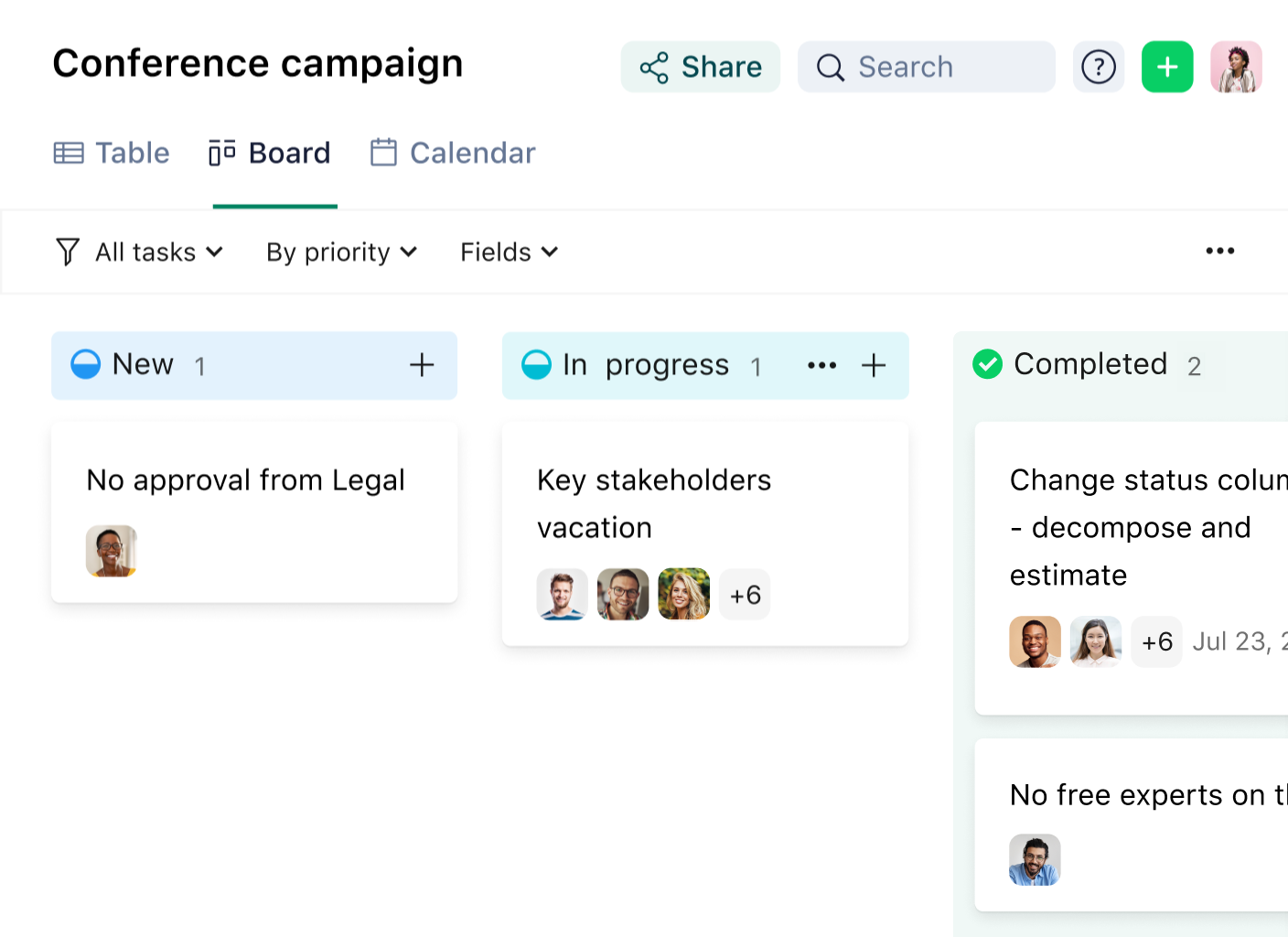
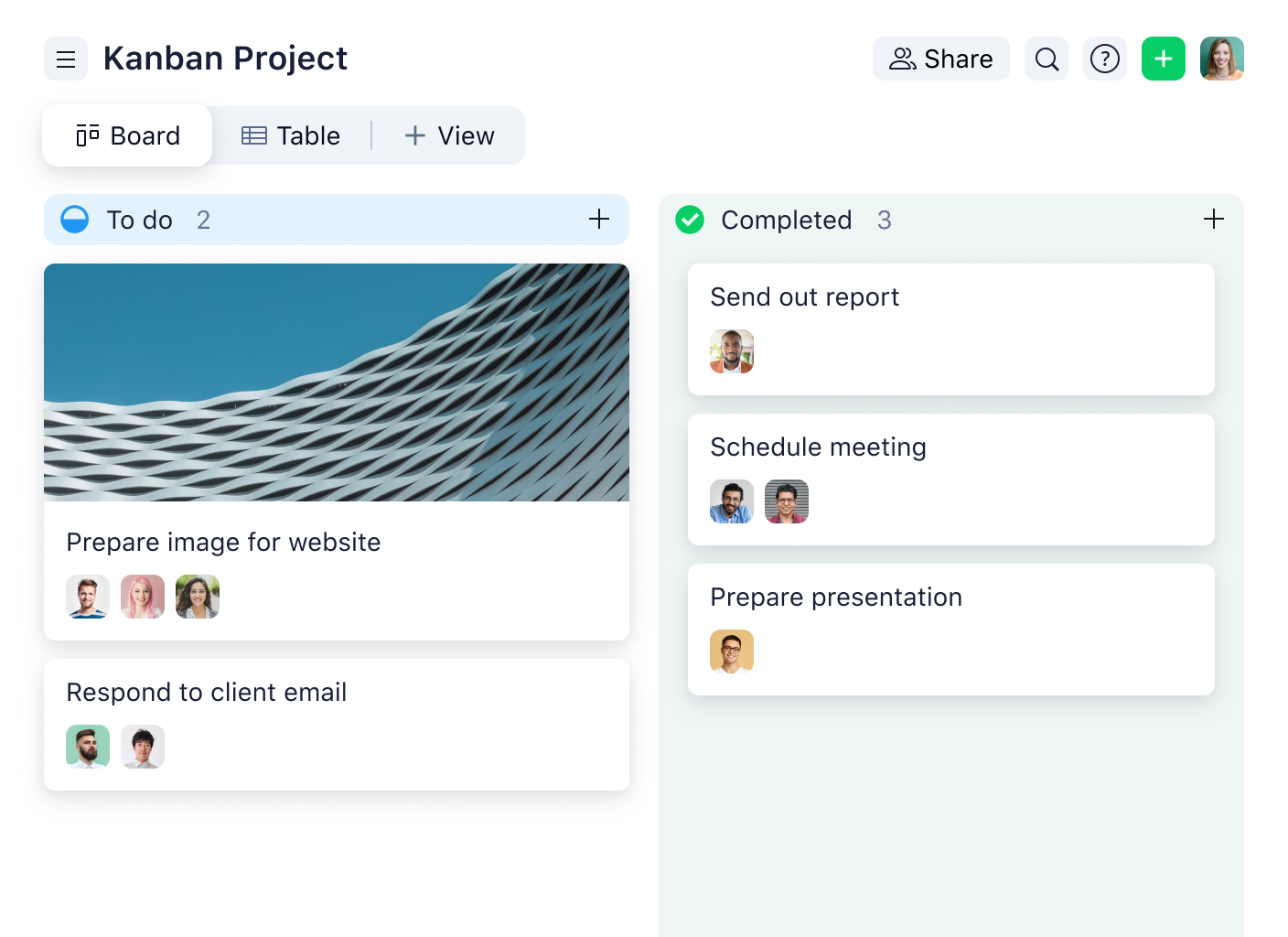
In its simplest form, a Kanban board features three stages:
- To do
- In progress
- Completed
You can also add more stages to best serve a particular process, e.g., adding a “Review” stage between “In progress” and “Done.”
Example: At Brief Media, the company has improved on-time delivery of projects by 50%. Its teams use Wrike dashboards, such as Kanban boards, to create customized workflows and improve visibility across departments. Each team member can access all their tasks from a single Wrike page, eliminating the need to search through multiple folders.

2. Limit work in progress (WIP)
A key Kanban practice is limiting WIP to avoid overload and keep workflows moving smoothly. Using a pull system, new tasks are only added when the team has capacity, ensuring efficiency, balance, and higher-quality output.
Example: At Arvig, adopting Wrike for enterprise-wide project management saved the HR team 900+ hours a year on administrative work and helped it greatly reduce project durations. Shaun Carlson, Director of R&D and Continuous Innovation at Arvig, said:
“With Wrike, projects that had taken nine months to complete now take 16 weeks. Today, we can manage 250% more projects, which means we can be more responsive, increasing customer satisfaction.”
3. Manage flow
Kanban focuses on managing the workflow across the board. Project managers track tasks, identify bottlenecks, and adjust processes to keep progress steady.
Monitoring flow improves efficiency and helps prevent burnout while ensuring consistent delivery.
Example: At Blue Yonder, adopting Wrike helped the marketing team manage flow and gain full visibility into projects. After comparing several project management tools, the team chose Wrike for its flexibility, visual interface, and ability to manage complex marketing workflows. PT Umphress, the Global Director of Digital Marketing Operations at Blue Yonder said:
“When we switched to Wrike, it was like turning on all the lights. Now everybody can see — there’s everything we need.”
4. Make policies explicit
Clear process policies are essential in Kanban. By defining rules, requirements, and what “done” means, teams reduce confusion and make decisions based on objective standards. Transparency ensures accountability and smoother collaboration.
5. Implement feedback loops
Feedback is central to continuous improvement in Kanban. Regular reviews, meetings, and performance metrics provide insights that help teams adapt quickly, improve workflows, and deliver better results over time.
6. Improve collaboratively, evolve experimentally
Kanban encourages teams to improve through collaboration and experimentation. By making small, data-driven changes and measuring results, organizations can continuously evolve processes while reducing risks and increasing efficiency.
In his book, David J. Anderson talks about teams having a shared comprehension of problems and suggests the adoption of a model to predict the effect of change. These include:
- The Theory of Constraints
- The Theory of Profound Knowledge
- The Lean Economic Model
By using a proven model, it becomes easier to measure outcomes, including the changes leading to them. This helps retain clarity and mitigate risks.
Example: At ASU Enterprise Partners, Wrike transformed collaboration and brought clarity to complex, high-volume projects. By using Wrike dashboards to manage over 500 projects each year, the team gained a clear, real-time view of priorities, workloads, and progress across departments. Jesse Knittel, Assistant Project Manager, said:
“Without Wrike, we couldn’t keep up with our workload. It’s brought transparency and alignment to our teams — where there used to be guesswork and missed deadlines, now there’s clarity and efficiency.”
Integrate Kanban principles with WrikeReady to manage projects using Kanban principles? Wrike’s customizable Kanban boards and prebuilt project templates let you tailor workflows, visualize progress, and eliminate silos.

Companies like MTD report faster delivery and higher responsiveness after adopting Wrike — proving how quickly Kanban principles translate to real-world gains. Ryan Cmich, Chief Products Engineer at MTD, shared:
“When the software team is together looking at their work in a Kanban style using Wrike’s custom dashboards, they can see where things are sitting in that process.”
Bring Kanban principles to life in your projects today — choose Wrike.
FAQs about Kanban principles
Kanban follows a set of core principles and practices that guide teams in managing workflows efficiently and improving continuously.
The four core principles of Kanban are:
- Start with what you do now
- Agree to pursue incremental, evolutionary change
- Respect the current process, roles, responsibilities, and titles
- Encourage acts of leadership at all levels in your organization
The six practices of Kanban are:
- Visualize (the work, workflow, and business risks)
- Limit work in progress (WIP)
- Manage flow
- Make policies explicit
- Implement feedback loops
- Improve collaboratively, evolve experimentally
Wrike supports Kanban in project management by combining visual task boards with advanced collaboration, automation, and reporting features. Teams can easily adjust workflows, set priorities, and monitor progress in real time. This helps streamline communication, improve transparency, and ensure projects stay aligned with Agile goals.
Wrike visualizes Kanban workflows through its Board view, where each workflow stage appears as a column and tasks are represented by cards. Teams can create custom columns to match their specific process, assign tasks to team members, and update progress by dragging cards between columns to automatically reflect their current status.
Wrike supports hybrid workflows that blend Kanban and Agile principles through customizable Kanban boards, multiple project views, and built-in automation. Teams can adapt and combine elements from various methodologies to design a workflow that fits their specific processes, creating a more flexible and efficient system.
Kanban can be managed using Wrike’'s digital project management tools. Wrike’s Kanban Project template helps teams break down work into tasks, organize them on a Board view with columns (such as “To-Do,”, “Doing,” “Done”), assign tasks to team members, and track progress as tasks move through each stage. This set-up makes it easy to manage workflows visually, limit work in progress, and keep projects moving efficiently.
Yes, Wrike can handle multiple teams and boards using Kanban simultaneously. Teams can build and manage separate boards for different projects or functions, while a single portfolio-level Kanban board can bring together work from several teams into one unified view. Custom dashboards with filters also make it easy to track tasks and progress across multiple teams or projects simultaneously.
The limitations of Kanban include the absence of time constraints, which can slow delivery, and the need for consistent updates to keep the board accurate and useful. It also lacks the defined structure and predictability of frameworks like Scrum, making it harder to manage dependencies and external timelines. Additionally, Kanban’s success depends heavily on team discipline and commitment to maintaining the process.