


Key takeaways:
- What is marketing campaign management? Marketing campaign management is the operational layer that coordinates people, timelines, assets, and approvals across five campaign stages: intake, planning, execution, reporting, and optimization.
- What are the five stages of campaign management? Intake (how work enters your queue), planning (scope, timeline, and resources), execution (workflows, proofing, and approvals), reporting (real-time visibility and performance data), and optimization (retrospectives and template refinement). Each stage builds on the one before it.
- How should you start building and optimizing your campaign management? Start where the pain is sharpest. Chaotic task requests? Fix intake. Slow approvals? Implement better execution workflows. Can’t answer “how’s the campaign going?” without a scramble? Focus on reporting and integrations.
- What should you look for in campaign management tools? Request forms, visual timelines, proofing tools, dashboards, and integrations with your existing stack are usually a must for most teams. However, look for capabilities that match your needs and the stages where your campaigns break — not generic feature checklists.
- How do campaign management systems improve over time? Through deliberate optimization in how you run campaigns, conduct retrospectives, and update templates. Small refinements compound — a 30-minute savings per campaign becomes 50 hours across a year.
Picture this. Your Q3 product launch campaign had the right strategy. The creative was strong. The channels made sense for the audience. And it still launched two weeks late because the design team didn’t know the brief had been updated, legal delayed approvals for six days, and three stakeholders gave feedback in three different places.
This wasn’t a strategy failure. It was an operational failure.
Many marketing teams run the same fire drill every campaign: scrambling to clarify scope and managing tasks and priorities across Slack, Notion, and spreadsheets, while constantly chasing down approvers. Then the campaign ships, everyone exhales, but the same problems repeat next quarter.
These failures persist because most teams pour energy into campaign creation — the strategy, the messaging, the creative — without building the operational infrastructure to actually execute it. Campaign management is that infrastructure: the layer that keeps all moving parts running smoothly between “we should run a campaign” and “that campaign delivered results.”
Unlike most guides that focus almost exclusively on campaign creation, this one breaks down the complete process of marketing campaign management across five stages:
- Intake
- Planning
- Execution
- Reporting
- Optimization
At each stage, we’ll show real examples of how Wrike helps marketing teams solve the specific problems that derail campaigns, so you can build a system that compounds improvements instead of repeating mistakes.
What is marketing campaign management?
Campaign management is the operational infrastructure that covers how requests enter your queue, how work moves across teams, how approvals get unstuck, and how you measure campaign objectives.
The challenge is that most of these campaign activities are invisible until they break. For example, requests start falling through cracks, legal sits on assets for a week, and reporting dashboards don’t get built until leadership asks basic questions about the campaign’s status.
A campaign manager’s job is to make this invisible work visible and systematic, so your marketing efforts don’t go to waste.
They’re not executing individual tasks so much as designing the system that lets everyone else execute without constant coordination overhead. The difference between a good campaign manager and a great one is whether each campaign requires reinventing how the team works, or whether the system compounds improvements over time.
The 5 stages of marketing campaign management
With the definition out of the way, let’s focus on the specific stages of campaign management. While these may vary across teams, most campaigns will go through some form of each stage, so it’s important to have this theoretical framework at your disposal.
Stage 1: Intake – Streamlining how work enters your queue
For some digital marketing teams, intake is where campaigns start dying before they’re born. It’s the foundation everything else builds on.
A product manager mentions a launch during a work backlog review. A sales director emails asking for “campaign support.” An executive forwards a competitor’s ad with three words: “We should respond.” Each request lands on a different desk, with different urgency implied but never stated. The campaign manager spends the first three days chasing basic information: What’s the objective? Who approved the budget? Is this a priority or a “nice to have?”
Capgemini’s North American Marketing Services team lived this pattern. “Since we had a decentralized system in place to gather and manage those requests, it was hard to understand what every team member was working on at any given moment,” says Dan Stevens, Director of Marketing Services.
The difference between basic intake and effective intake: basic intake collects information. Effective intake triggers action.
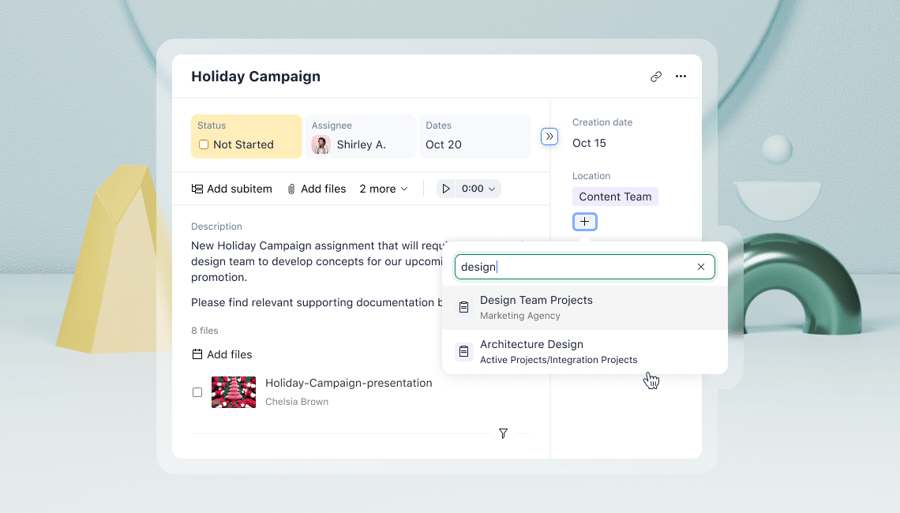
Structured intake means a single, standardized entry point for all campaign requests. For example, in Wrike, dynamic request forms use conditional logic to ask different questions based on campaign type.
For example, a product launch form asks about messaging approval status. An event promotion form asks about registration targets. When someone submits a request, Wrike can automatically generate a project from a prebuilt template: task lists, assigned owners, workflow statuses, and timeline estimates.

“Once we have the initial project discussion, we identify all project deliverables and milestones and create the associated tasks directly within Wrike,” Stevens explains. The questions you’d spend a week chasing through email get answered at submission. The campaign manager sees every active request in a single view and allocates resources intelligently rather than reactively.
Stage 2: Planning – Organizing campaigns for success
While everyone knows the importance of planning, most campaign plans aren’t plans. They’re launch dates with vague tasks surrounding them.
The team knows the campaign goes live on October 15. But nobody has mapped which tasks depend on which, who owns what, or whether the designer is buried in three other projects that week. Then week two arrives: the copywriter finishes the email draft, but nobody briefed the designer on the landing page. The paid media manager asks for creative and discovers assets are in legal review. That’s how launch dates start slipping.
The difference between planning that works and planning that doesn’t comes down to visibility.
Matt Andrews at Aerotek coordinated campaigns across six marketing teams. Before structured planning, even short campaigns generated a certain amount of chaos. “Some projects that only lasted four or five weeks had hundreds of emails, which is excessive.”
Aerotek now runs planning through Wrike. “We put all of this in Wrike and use it as a guide for our meetings, allowing us to consolidate a lot of conversations and have more meaningful meetings,” Andrews says. The result: “We shaved off about a week and a half of what we typically go through for a planning cycle.”

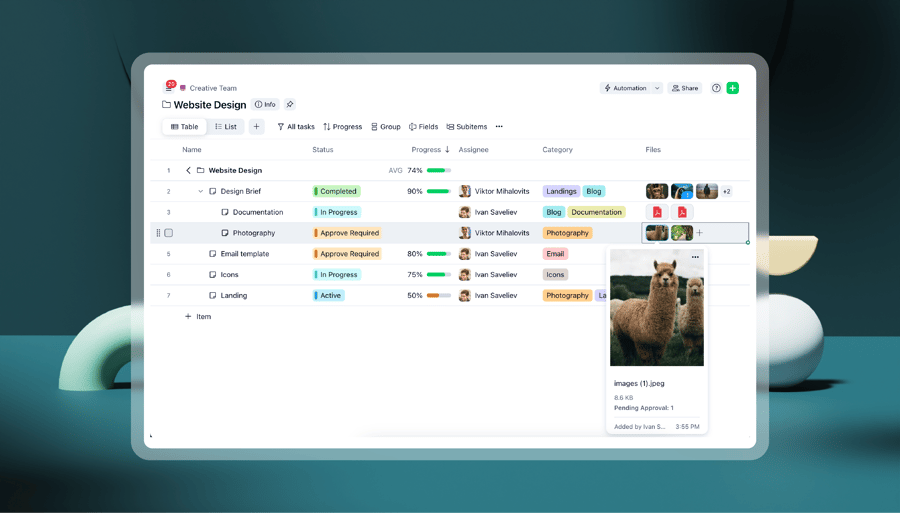
In Wrike, campaign planning happens through folder structures with nested tasks, owners, due dates, and dependencies mapped visually through Gantt charts. Cross-tagging lets a single task appear in multiple contexts: the landing page design lives in both the campaign folder and the design team’s Workload view. When the designer checks their queue, they see every campaign competing for their time, not just the one yelling loudest.
A week spent planning well saves three weeks of firefighting later.
Stage 3: Execution – Running campaigns without the chaos
Execution is where plans face reality.
The copywriter finishes a draft and emails it to the designer. The designer has questions and Slacks the copywriter. Legal’s feedback arrives in email. Product’s comments live in a Google Doc. No single place contains the complete picture, so everyone operates on partial information.
Three failure modes compound: workflows stall when handoffs aren’t explicit, team collaboration fragments when communication happens in channels instead of context, and visibility disappears when status lives in people’s heads.
The difference between execution that works and execution that doesn’t is whether the system holds the state or people do.
The Moneytree marketing team relied on email for proofs, revisions, and approvals before implementing structured workflows. “It was difficult sending one PDF out for review to multiple people for feedback,” explains Alex B., Marketing Project Manager. “Keeping track of all the different feedback and changes was more of a manual, time-consuming process.”
Wrike’s proofing was the deciding factor. “The ability to leave direct comments, have a conversation, and document it all in one place was really big for us,” Alex says.

With custom workflows, when a task moves to “Under Review,” the reviewer gets notified automatically. Reviewers markup directly on assets, comments anchor to specific locations, and approval decisions are explicit. “The tool is interactive and we see everything in real time,” says Denise R., VP of Marketing & Training. “I have visibility on all projects and don’t need to bother anyone else for updates.”
The result? Moneytree’s approval time dropped from seven days to four. Projects now move 75% faster from start to final approval.
Stage 4: Reporting – Proving campaign impact
“How’s the campaign going?” triggers a scramble. Pull data from ad platforms. Export results from the email tool. Check the project management system. Copy everything into a spreadsheet. Build charts to measure success with metrics and KPIs like conversion rates, ad spend, and acquisition costs — right before an important meeting.
This is reactive reporting: assembling information on demand because no system maintains it continuously.
The shift that changes everything is moving from reactive to ambient reporting. Instead of assembling information when someone asks, the system should maintain a continuously updated picture.
James Ball, Vice President of Project Management at Jellyfish, has some experience in trying to manage client engagements like this. Information was fragmented across email, Slack, and Google Sheets. When stakeholders needed summaries, someone spent hours synthesizing scattered threads.
All of this was transformed by Wrike. During one video call, James needed to summarize a complex project thread, a previously time-consuming exercise.
“I just clicked the button in Wrike and watched everyone’s jaws drop as it instantly did the work that probably would have taken me a couple of hours, right before their eyes.”

Wrike’s AI summary generated a comprehensive synthesis in seconds. The 95% reduction in time spent on summaries changes the economics of reporting entirely. When synthesis takes two hours, you do it reluctantly. When it takes seconds, you do it whenever anyone needs context.
“When the client tells me how much they love what we’re doing in the Wrike platform, and how this is a hundred times better than any processes they had with their previous agency, I know that we’re doing something special,” James says.
Stage 5: Optimizing – Learning and improving
This final stage is usually the most neglected.
The campaign launches. Results come in. The post-mortem gets scheduled, rescheduled, then dropped. Three months later, the team runs the same fire drill: scrambling for approvals, discovering missing assets late, and compressing unrealistic timelines.
The difference between teams that improve and teams that repeat is whether learning gets encoded into the system or evaporates after the meeting.
Campaign retrospectives create raw material for improvement. But most fail even when they happen. Someone says, “We should start legal review earlier next time.” Everyone nods. No one updates the template or streamlines the process. Three months later, the same problem recurs.
Template refinement can turn insights into structural change. “Onboarding Wrike forced us to interrogate our existing processes,” explains Alex B. at Moneytree. “We believe they work better for us now. That has made onboarding new people much easier.”

Once processes live in templates rather than tribal knowledge, improvement becomes concrete: update the template, and every future campaign inherits the fix.
This is how blueprints become institutional memory. The template isn’t just a starting point — it’s a cumulative record of everything the team has learned.
In Wrike, retrospective insights flow directly into blueprint updates. Historical data enables comparison: How does this new product launch compare to previous ones? Are there patterns in which workflows correlate with stronger outcomes?
Teams that optimize don’t work harder. They just stop solving the same problems repeatedly.
Common types of marketing campaigns
The five-stage lifecycle we just went over gives you the structure. However, a product launch doesn’t have the same intricacies as an always-on campaign for social media platforms or an email lead generation campaign, and treating them identically is how teams get blindsided.
That’s why it’s important to always consider the specific campaign goals, customer journey stages (e.g., potential customers, new customers, and loyal ones), and marketing channels. To help with that, we’ll cover the most popular types of marketing campaigns.
Product marketing campaigns
Product launches compress everything into an immovable deadline. Product, sales, customer success, and marketing all have equities in the messaging. Website, email, sales materials, and advertising must align simultaneously — and the launch date rarely moves when something slips.
Where it breaks: Intake and planning. Miss a dependency early — legal review, sales enablement, localization — and the whole timeline unravels with no room to recover.
Email marketing campaigns
Email campaigns multiply fast: multiple sends, segments, and variations. A/B testing doubles the assets. Personalization triples the QA burden.
Where it breaks: Execution. Without clear handoffs between copy, design, and QA, errors slip through. Without version control, you may find yourself sending the wrong variation to the wrong segment.
Content marketing campaigns
Content operates on longer timelines with more creative latitude. A single eBook might take six weeks from ideation to publication. An editorial calendar might have thirty pieces at different stages.
Where it breaks: Planning. No single deadline feels urgent, so individual pieces stall. Writers wait on briefs. Designers wait for drafts. SEO feedback arrives after the piece is already designed. Momentum dies in the handoffs.
Social media campaigns
Social media requires volume and real-time responsiveness. A campaign might involve dozens of posts across platforms, community engagement, paid amplification, and daily iteration based on what’s performing.
Where it breaks: Reporting and optimization. Without real-time visibility, you can’t pivot. By the time you realize a creative isn’t working, you’ve already spent half the budget on it.
Brand awareness campaigns
Brand campaigns span months and touchpoints. Consistency matters more than speed. Direct attribution is difficult, which makes proving ROI harder.
Where it breaks: Execution. Without strong proofing workflows, brand inconsistencies creep across channels. Without documented guidelines in the system, every new stakeholder runs the risk of introducing drift.
What to look for in marketing campaign management tools
Many teams evaluate campaign management software by feature count. They compare checklists of functionalities: Does it have Gantt charts? Does it have Kanban boards? Does it integrate with Slack?
This is backwards. Features don’t matter as much as the tool supporting the stages where your campaigns actually break.
If your campaigns consistently stall at intake — requests arriving incomplete, scope unclear, priorities competing — you need robust request forms with conditional logic and auto-generated project structures. A tool with beautiful Gantt charts but a clunky intake system won’t solve your problem.
If execution is where things tend to go wrong — approvals bottlenecked, feedback scattered, handoffs missed — you need proofing tools that consolidate review in context, workflows that auto-notify reviewers, and version control that creates an audit trail. A tool with great reporting but weak approval workflows won’t help.
Your evaluation framework should follow the lifecycle we laid out:
- Intake: Standardized request forms. Auto-generated projects from submissions. Routing logic that gets requests to the right queue without manual triage.
- Planning: Visual timelines with dependencies. Resource visibility across campaigns, not just within one. Cross-tagging so tasks live in multiple contexts simultaneously.
- Execution: In-context proofing and markup. Automated approval routing. Version control with documented audit trails.
- Reporting: Real-time dashboards without manual compilation. Customizable views for different stakeholders. Scheduled distribution.
- Optimization: Searchable historical data. Updatable templates that propagate improvements. Cross-campaign comparison.
Beyond stage-specific capabilities, evaluate whether the tool integrates with your existing stack, including creative tools, communication platforms, CRMs, and marketing automation. A campaign management tool that doesn’t connect to where your team already works becomes a data entry chore rather than a central hub and single source of truth.
How to get started with Wrike’s marketing campaign management template
Building campaign management infrastructure from scratch takes months. You may find you design intake forms, configure workflows, create dashboards, and optimize the process — and then realize some part doesn’t match how your team works.
Templates help solve this problem. You can start with a working structure and then run your first campaign through it this week. That means you’re executing immediately rather than planning indefinitely.
Wrike’s Marketing Campaign Management template gives you this exact foundation:
- Request forms capture campaign briefs and auto-generate projects with tasks, owners, and timelines assigned
- Folder structures with nested tasks, subtasks, and dependencies already mapped
- Custom workflows for campaign phases and creative review, with approval routing built in
- A campaign tracker dashboard showing active campaigns, status, milestones, and items needing attention
- A campaign calendar displaying all work chronologically to spot scheduling conflicts
- Proofing tools that consolidate feedback directly on assets with version control
The teams that get the most value treat the template as a living system. After a few campaigns, they notice patterns — a task that’s always missing, a status no one uses, a question the request form should capture. Small refinements compound. Within a quarter, the template reflects how their team actually works, not just how it started.
But that evolution is the upside, not a prerequisite. The template works on day one. Everything after that just makes it work better.
Frequently asked questions (FAQs) about marketing campaign management
What is marketing campaign management?
Marketing campaign management is the process of planning, executing, tracking, and optimizing marketing initiatives. It encompasses various marketing activities, including coordinating people, timelines, assets, and approvals to ensure campaigns launch successfully and deliver results. While related to marketing strategy and creation, campaign management focuses specifically on the orchestration and execution layer.
What are the four stages of a marketing campaign?
The traditional four stages are planning (setting objectives and strategy), execution (creating and deploying assets), monitoring (tracking campaign performance), and analysis (evaluating results after completion).
However, this framework often misses critical stages. We recommend a five-stage lifecycle that adds intake (how work enters your queue) at the beginning and emphasizes optimization (systematic learning and improvement) at the end.
What is the 40-40-20 rule in marketing?
The 40-40-20 rule is a classic direct marketing principle developed by Ed Mayer. It states that 40% of campaign success depends on reaching the right audience, 40% depends on the offer, and only 20% depends on creative execution.
The modern interpretation: don’t over-invest in creative polish before validating your audience targeting and offer. The most beautifully designed campaign will fail if it reaches the wrong people with an offer they don’t want. This principle argues for prioritizing the audience and offering a strategy before committing resources to creative production.
What are the key components of a marketing campaign?
Every effective marketing campaign has clear objectives (what success looks like), target audience (who you’re trying to reach), key messages (what you want to communicate), channels (where you’ll reach your audience), budget (what resources you’ll invest), timeline (when things happen), and key metrics (how you’ll measure results).
Beyond these strategic components, campaigns also require operational components, such as task assignments, workflows, approval processes, and reporting structures.
Why is marketing campaign management important?
Without deliberate management, marketing campaigns tend toward chaos as they scale. Work falls through cracks. Timelines slip without anyone noticing until it’s too late. Feedback loops take too long. The same mistakes repeat because lessons aren’t captured.
Effective campaign management keeps teams aligned on priorities, ensures consistent execution quality, provides visibility into what’s happening, enables measurement and optimization, and creates systems that improve over time. As marketing teams run more campaigns with more complexity, the operational layer becomes the difference between scaling successfully and drowning in coordination overhead.