
Wrike logo.
    • For teams
      • Marketing

        Streamline proofing and reporting for seamless campaigns.

      • Creative & Design

        Create high-quality assets and get them approved in record time.

      • Product

        Accelerate your product process, from idea to delivery.

      • Client Services

        Exceed clients’ expectations with expert resources.

      • PMO

        Align strategy with execution and deliver results.

      • IT

        Execute initiatives, optimize workflows, and automate requests.

      • Operations

        Make work flow seamlessly with intuitive management tools.

      • HR

        Manage teams effortlessly with customizable HR features.

      • Legal

        Organize every file, case, and due date in one secure space.

      • Finance

        Centralize all financial tasks, from budgeting to invoicing.

      • See all teams

    • Workflows
      • Campaign Management

        Make marketing magic with end-to-end campaign management.

      • Agency Management

        Take full control of your agency management processes.

      • Client Service Delivery

        Get ahead of the competition with faster client services.

      • Product Lifecycle

        Watch your product lifecycle flow, from concept to customer.

      • Project Portfolio Management

        Manage your complete portfolio, from strategy to results.

      • Creative Production & Content

        Create, collaborate, proof, and approve all in one place.

      • Workflow Management

        Use custom statuses and automate your team workflows.

      • Project Management

        Plan Agile projects, track deadlines, and deliver results.

      • See all workflows

    • For industries
      • Technology

        Build solutions that matter, and deliver faster.

      • Manufacturing

        Enhance operations, accelerate production, and empower teams.

      • Professional Services

        Organize clients, streamline projects, and automate workflows.

      • Finance

        Deliver better, faster financials with automations.

      • Healthcare

        Collaborate cross-functionally in a secure setting.

      • Education

        Unite multiple disparate teams, departments, and colleges.

      • Construction

        Streamline building projects, from scoping to invoicing.

      • Media & Entertainment

        Choose one powerful platform for fast-paced work.

      • See all industries

    • Explore Wrike
      • Take a Product Tour

      • Book a Demo

      • ROI Calculator

      • Customer Stories

      • Start with Templates

    • Features
      • Dashboards

        Fuel better, faster, data-driven decisions with powerful analytics.

      • AI

        Learn about powerful AI and automations with Work Intelligence®.

      • Wrike Whiteboard

        Turn inspiration into execution with powerful visualization tools.

      • Gantt Charts

        Interactive project scheduling across teams.

      • Automation

        Define and trigger automated workflows to eliminate manual efforts.

      • Proofing

        Streamlined proofing and collaboration in one place.

      • Project Resource Planning

        Plan and allocate resources for timely delivery.

      • Project Views

        Get the full picture with customizable, intuitive project views.

      • Kanban Boards

        Instantly view project progress and create customized workflows.

      • Dynamic Request Forms

        Custom forms powered by conditional logic.

      • Approvals

        Keep approvers in the loop from start to finish.

      • Custom Item Types

        Tailor work items to fit your specific workplace.

      • See all features

    • Platform
      • Book a Demo

      • Start with Templates

      • Wrike AI

      • Integrations

      • Security

      • Mobile & Desktop Apps

    • Workflow-Powered Collaboration

      Sync with multiple teams to keep work flowing across your organization.

    • Industry-Leading Security

      We're dedicated to safeguarding data beyond industry standards and ensuring secure collaboration.

    • Pioneering AI and Innovation

      Put the power of data and AI to work for your organization.

    • Invested in Customer Success

      We support customers at every step of their journey from pre-sales to onboarding with 24/7 support.

    • Boundless Configuration

      Customize your workspace to suit the unique needs of every team in your organization.

    • Effortless Scalability

      Add new teams or adjust to rapid growth seamlessly with Wrike’s scalable platform.

    Need an extra team member?
    Build your own agent with Wrike and save 10 hours per week per project.
    Try AI agents
    • Go deeper
      • Resource Hub

        Top assets on productivity, collaboration, and more.

      • Wrike Blog

        Latest news and best practices on project management.

      • Educational Guides

        Guides and tools to unlock better work management.

      • Webinars

        Join our live or on-demand sessions to do your best work.

      • Customer Stories

        Explore Wrike’s case studies for key insights on customer success.

      • Developers

        Connect and build integrations with easy-to-use APIs.

    • Upskill and Connect
      • Training & Certifications

      • Help Center

      • Wrike's Community

      • Premium Support Packages

      • Wrike Professional Services

      • What's new

    Catch up on our most exciting product updates in 2025!
    2025 was another landmark year for Wrike, with some of our most exciting releases yet.
    Watch the video
  • Enterprise
  • Pricing
Contact Sales
  • Language selector dropdown with globe icon and list of available languages.
    English
    Dansk
    Deutsch
    Español
    Français
    Bahasa Indonesia
    Italiano
    Bahasa Melayu
    Nederlands
    Norsk
    Polski
    Português (BR)
    Svenska
    Русский
    日本語
    한국어
    中文 (简体)
    中文 (繁體)
Log in
Wrike logo.
Wrike logo.
  • Guide overview
    • What Is the Agile Manifesto?
      • Who created the Agile Manifesto?
      • The four Agile Manifesto values
      • The 12 Agile Manifesto principles
      • Why is the Agile Manifesto important?
      • How to use the Agile Manifesto
    • Agile vs. Waterfall
      • Agile vs. Waterfall: An overview
      • Agile vs. Waterfall: Key differences
      • Differences between Agile and Waterfall in real projects
      • Agile vs. Waterfall pros and cons
      • Can Agile and Waterfall be used together? 
      • How to choose between Agile and Waterfall
      • Decide with Wrike
    • The Benefits and Advantages of Agile
      • Why is Agile so popular?
      • The benefits of Agile
      • The advantages of Agile
    • What Is Agile Operations?
      • The history of Agile in IT operations
      • Benefits of Agile IT operations
      • How to implement Agile IT operations
      • How Wrike can help with Agile IT operations
    • What is Agile Product Management?
      • Why product management needs agility today
      • Agile product management approach
      • Key principles of Agile product management
      • The role of the Agile product manager 
      • Strategic responsibilities
      • Tactical responsibilities
      • Day-to-day collaboration
      • Product manager vs. product owner
      • The Agile product management lifecycle 
      • Product discovery in an Agile context
      • Working with Agile delivery frameworks
      • Scrum
      • Kanban
      • What matters more than the framework
      • Common pitfalls and how to avoid them
      • Tools and practices that support Agile product management
      • Getting started with Agile
    • The Agile Software Development Life Cycle
      • The six phases of the Agile life cycle
      • The Agile iteration workflow
      • Manage your Agile life cycle with Wrike
    • Building an Agile Team Structure
      • Team structure: Traditional vs. Agile
      • Types of Agile team structure
      • Agile team: Key roles and responsibilities
      • How to build an Agile team structure
    • A Guide to the Scaled Agile Framework (SAFe)
      • Key takeaways
      • What is the Scaled Agile Framework?
      • What is the foundation of SAFe?
      • What are the principles of SAFe?
      • Lean-Agile mindset 
      • Economic view
      • Systems thinking
      • Manage variability 
      • Incremental building 
      • Milestones based on evaluating working systems 
      • Work in progress (WIP) limits 
      • Synchronized cadence 
      • Intrinsic motivation 
      • Decentralized decision-making 
      • Value-based organization
      • Flow 
      • Team and technical agility 
      • Built-in quality 
      • Program Increment (PI) planning 
      • What are the four levels of SAFe?
      • 1. Essential SAFe
      • 2. Large Solution SAFe
      • 3. Portfolio SAFe
      • 4. Full SAFe
      • What Are the Benefits of SAFe?
      • Enhanced collaboration and teamwork 
      • Improved efficiency and productivity 
      • Faster time to market 
      • Increased innovation and competitiveness
      • Better alignment with business goals and objectives 
      • Portfolio visibility and funding alignment
      • Governance without losing agility
      • Cross-team dependency management
      • Predictable delivery at scale
      • Is SAFe right for your company?
      • When should you use SAFe?
      • SAFe vs. Scrum
      • SAFe vs. Kanban
      • SAFe vs. Lean-Agile
      • SAFe vs. Scrumban
      • How SAFe Supports Agile at Scale
      • How teams operationalize SAFe with Wrike
      • Planning increments with shared timelines
      • Tracking dependencies across teams
      • Coordinating cross-team work in one system
      • Maintaining visibility across portfolios
      • Implement SAFe in your organization with Wrike
    • Agile and Lean Portfolio Management
      • What is Agile portfolio management?
      • What is Lean portfolio management?
      • Why choose a Lean-Agile approach to portfolio management?
    • Understanding Squads, Tribes, and Guilds
      • The Spotify model
      • Should you create squad teams?
      • Build your own model
    • What Is Agile Transformation?
      • Agile transformation vs. Agile adoption
      • Agile transformation vs. digital transformation
      • Benefits of Agile transformation
      • Challenges of Agile transformation
      • Steps to Agile transformation
    • Themes, Epics, Stories, and Tasks in Agile
      • The Agile work structure
      • Top tips for your Agile structure
    • A Complete Guide to Agile Epics
      • What is an epic?
      • Examples of epics
      • Benefits of epics
      • How to write epics
    • How to Create User Stories
      • What is a user story?
      • User story examples
      • 5 steps for writing user stories
      • What makes a good user story?
      • Benefits of user stories
      • Disadvantages of user stories
    • Agile Estimation Techniques
      • Core Agile estimation techniques
      • Relative sizing (the Agile standard)
      • Planning poker
      • Affinity grouping
      • T-shirt sizes
      • Story point assignment
      • Hourly estimation
      • Effort estimation
      • Common Agile estimation pitfalls and anti-patterns 
      • The commitment trap
      • Converting points to time
      • Estimation by proxy
      • Inflation and sandbagging
      • Misunderstanding the scale
      • Wrike for Agile estimation
    • Agile Estimation: Understanding Story Points
      • Why use story points?
      • Top tips for story points
    • Using Gantt Charts in Agile
      • What is an Agile Gantt chart?
      • Why do Agile teams use Gantt charts?
      • How to use an Agile Gantt chart
      • Benefits of Agile Gantt charts
      • Agile Gantt charts in Wrike
    • Glossary
    • FAQs
      • Agile Frameworks And Techniques
      • Agile Teams
      • Basics Of Agile
      • Guidelines For Agile Projects
      • Optimizing Agile Projects
    1. Home
    2. Agile Guide

    What is Agile product management? A complete guide

    7 min readLAST UPDATED ON MAR 5, 2026
    Alex Zhezherau
    Alex Zhezherau Product Director, Wrike

    Planning a product roadmap months in advance is often like predicting the exact weather for a Tuesday in October. You start with high hopes and usually end up soaked because you did not account for a sudden downpour. It is time to stop treating your product as a fixed destination and start treating it like a moving target. 

    The Agile Manifesto, created in 2001, outlines values and principles that prioritize customer collaboration, adaptability, and the delivery of working software in short, iterative cycles. These foundational ideas underpin modern Agile product management and guide teams toward more flexible and responsive practices.

    Agile product management is the practice of steering a product through iterative cycles, prioritizing rapid delivery and continuous learning over rigid, long-term planning. By breaking development into manageable increments, this approach allows teams to respond to user feedback in real time rather than simply checking off a predetermined list of tasks. This mitigates the risk of building technically perfect but commercially obsolete products, ensuring every sprint aligns stakeholder goals with actual user needs to produce predictable, high-impact results.

    Let’s dive into why Agile is important for product management, as well as key principles, frameworks, and more!

    Try Wrike's template

    Why product management needs agility today

    Product management has always involved uncertainty. The difference now is that uncertainty moves faster, and unfortunately, the era of the five-year plan is over because market volatility has become the baseline. Consumer preferences can shift overnight, and competitors can disrupt entire categories in a single quarter.

    When you rely on a static product roadmap, you make your most important decisions at the point of your greatest ignorance: the very beginning of the project. Shorter development cycles are required to survive this volatility. Agility allows you to test hypotheses quickly and gather data before you have sunk six months of engineering budget into a feature that no one wants.

    Wrike Kanban board displaying project tasks across Request, Backlog, Ready, In Progress, Completed.Wrike Kanban board displaying project tasks across Request, Backlog, Ready, In Progress, Completed.

    Agile product management approach

    Agile product management is a major shift in how you view the product lifecycle. Traditional product management often relies on a hand-off culture where heavy documentation leads to a massive build phase and a high-stakes launch.

    An Agile approach changes four things in a meaningful way.

    1. Planning horizons become shorter and more layered. Teams still need a product vision and broader strategic themes, but near-term priorities are refined more frequently. Agile product management focuses on what should happen next and what needs to be learned before committing further.
    2. Decision cadence becomes more frequent. Product managers do not wait for a quarterly planning session to revisit assumptions. They adjust based on customer feedback, usage data, delivery insights, and new opportunities as they appear.
    3. Documentation style becomes lighter and more useful. Agile product management does not reject all documentation. It rejects documentation that takes a long time to create, becomes outdated quickly, and does not help the team make better decisions. 
    4. Feedback loops move closer to the work. Product decisions are informed by customer insight, team input, and product performance throughout the cycle, not only after something ships.

    Crucially, Agile product management is not just a collection of Scrum ceremonies or sprint planning sessions. It is a commitment to reducing decision latency — the time it takes to turn a new insight into a shipped feature.

    Key principles of Agile product management

    To prevent your product roadmap from becoming a “what I ordered vs. what I got” meme, an Agile product team must move beyond the mechanics of sprints and embrace these core principles: 

    • Customer centricity and continuous discovery: Maintain an ongoing dialogue to ensure the problem you are solving has not changed.
    • Outcome over output: Success is not measured by how many tickets you closed. It is measured by whether those tickets solved the customer’s problem.
    • Iteration and adaptability: Every release is an experiment. If the data says a feature failed, an Agile team has the humility to pivot.

    Transparency: Silos are the enemy. Product, engineering, and design must operate as a single unit with shared goals.

    The role of the Agile product manager 

    The Agile product manager wears many hats, but their primary goal is to ensure the team is always working on the highest-value items. Defining a clear product strategy involves understanding customer pain points and listening closely to customer needs, which helps guide prioritization and ensures the product evolves in response to real challenges and feedback.

    Strategic responsibilities

    An Agile product manager defines direction. That means understanding the market, identifying the right problems to solve, setting product goals, and ensuring the work aligns with broader business priorities. Strategy here is not a stale product roadmap artifact. It is an active decision-making framework that helps the team choose where to focus and what to deprioritize.

    Tactical responsibilities

    Tactically, they translate that strategy into work that the team can execute. They maintain priorities, refine the backlog, clarify scope, shape near-term decisions, and keep delivery aligned with the intended outcome. This is where they protect the team from drift and the irresistible corporate need to call everything urgent.

    Day-to-day collaboration

    Much of the role involves working with others. Agile product managers partner with a variety of other teams to answer questions, resolve trade-offs, and keep momentum. They are not there to make decisions; rather, to create enough clarity for the team to move with confidence.

    Product manager vs. product owner

    Some organizations separate these roles. The product manager usually focuses more on product vision, market understanding, and long-term prioritization. The product owner (a specific Scrum role) is often more focused on supporting delivery, refining backlog items, and helping the team stay aligned day to day.

    In smaller teams, one person may handle both. What matters is that strategic direction and delivery priorities stay tightly connected.

    The Agile product management lifecycle 

    Agile product management works best when you view the lifecycle as a continuous loop rather than a sequence of disconnected phases.
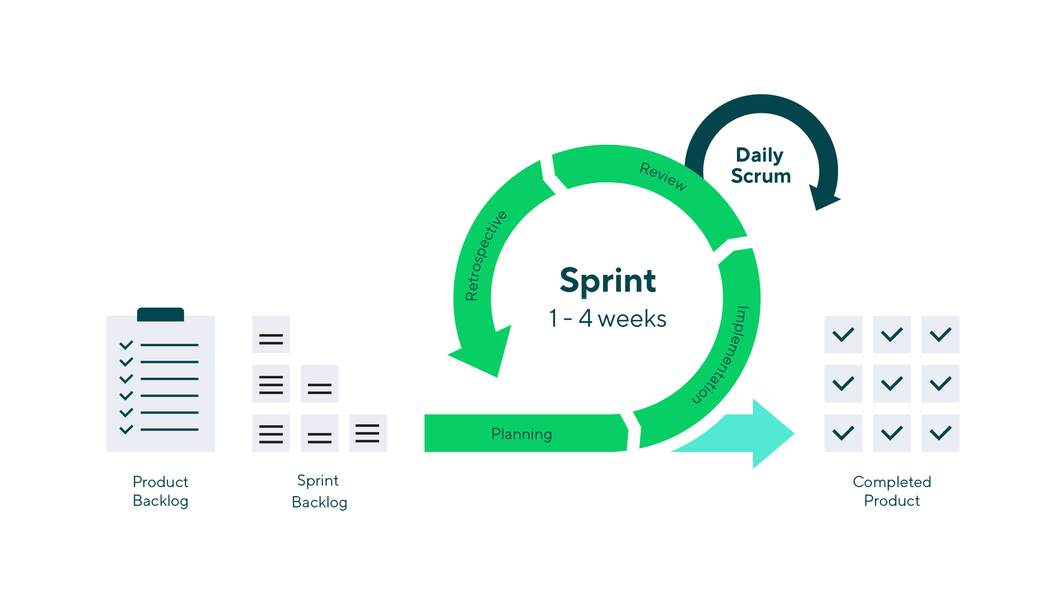
    How the Scrum sprint cycle works.How the Scrum sprint cycle works.

    Product discovery in an Agile context

    In an Agile world, discovery is not a phase that ends; it is a permanent state of being. Continuous discovery reduces the risk of building “shelf-ware” and accelerates learning.

    Teams often use dual-track Agile, where discovery (learning what to build) and delivery (building it) happen simultaneously. Common discovery tools include:

    • User interviews and surveys: For qualitative and quantitative insights.
    • Usability tests: To find friction in the UI.
    • Concierge/fake door tests: To validate demand for a feature before building it.

    The goal is to avoid the discovery trap where teams spend months researching but never shipping, or shipping without any research at all.

    Working with Agile delivery frameworks

    Choosing a delivery framework can sometimes feel like picking a side in a heated sports rivalry. Whether your team is team Scrum or team Kanban, the goal remains the same, and the framework you choose simply provides the guardrails for that journey.

    Scrum

    Scrum is built on a predictable cadence. It relies on sprints, time-boxed development cycles that typically last two to four weeks.

    • The product owner role: This individual acts as the primary link between stakeholders and the dev team, ensuring the backlog is always refined and prioritized.
    • Sprint goals: Every cycle begins with a specific objective. This prevents the team from drifting into a feature factory mindset and keeps everyone focused on a singular outcome.
    • Review cycles: At the end of each sprint, the team demonstrates the work to stakeholders. This immediate feedback loop ensures that if the team is off-track, they only lose a few weeks of work, not a few months.

    Kanban

    For teams that require more flexibility than a fixed sprint allows, Kanban offers a continuous delivery model. There are no predetermined start or end dates; work moves through the system as capacity allows.

    • WIP limits: Work-in-progress limits are the secret to Kanban success. By restricting the number of tasks in flight, you force the team to finish old work before starting new, instantly identifying and clearing bottlenecks.
    • Prioritization without sprints: In Kanban, the backlog is a living entity. Prioritization happens in real time, enabling rapid responsiveness to urgent market shifts or technical needs.

    What matters more than the framework

    It’s easy to get bogged down in the rituals of a specific methodology, but the framework is a means to an end. Whether you’re using Wrike AI agents to automate your backlog refinement or manually tracking tasks on a physical board, your success depends on your mindset.

    Common pitfalls and how to avoid them

    Agile product management solves real problems, but it also creates new ways to make old mistakes.

    One common issue is underspecification. In an effort to stay flexible, teams sometimes provide too little context, clarity, or alignment. That slows delivery and creates rework later. Agile should reduce waste, not create ambiguity for sport.

    Another is constant churn. If priorities shift every few days due to executive pressure, sales escalations, or the latest shiny request, the team loses focus, and delivery quality drops. Agile allows change, but it still needs boundaries. 

    Scope creep is an all-too-familiar problem. When goals are unclear or stakeholders treat delivery as endlessly expandable, work grows beyond its original value.

    A more subtle trap is shipping a lot without moving core metrics. Teams can look productive while making very little progress. If releases are frequent but adoption, retention, conversion, or customer satisfaction do not improve, output has replaced impact.

    There is also the risk of short-term thinking. If every decision is made to satisfy immediate pressure, the product loses coherence over time. Agile product management should make the team more adaptable, not more reactive.

    Finally, overpromising and political prioritization can undermine everything. When delivery dates are set for optics and priorities are driven by internal influence instead of evidence, product teams can end up moving quickly toward low-value work.

    Tools and practices that support Agile product management

    Agility requires a single source of truth. Without it, transparency fades and silos return.

    Wrike is the premier platform for supporting Agile product management. It allows teams to maintain a living backlog, visualize roadmaps, and manage resources in real time. By integrating your documentation and collaboration directly into your project management tool, you ensure that every team member understands the “why” behind every task.

    Getting started with Agile

    Agile product management is essentially the art of being wrong early enough to fix it. It marks the end of the guess-and-pray launch strategy and replaces it with a disciplined approach to learning and execution.

    Wrike is built to handle the logistical heavy lifting — from automated backlog refinement to AI agents with real-time risk detection — so you can spend your energy on strategy rather than status updates. Your product roadmap should be a living document that breathes with the market, not a dusty artifact of a meeting from six months ago.

    Ready to get started?

    Try Wrike's template
    Basics of Agile
    • 4 Pillars of Agile
    • Disadvantages of Agile
    • Agile Milestones
    • Agile Iteration
    • Agile Organization
    • Agile Personas
    • Timeboxes in Agile
    Agile Teams
    • Agile Team Charter
    • Agile Leadership
    • Agile Practitioner
    • Agile Mindset
    • Niko-Niko Calendar
    • Agile Release Train (ART)
    Agile Frameworks & Techniques
    • Agile Iron Triangle
    • Context Switching in Agile
    • FDD in Agile
    • Parking Lot in Agile
    • Disciplined Agile Delivery (DAD)
    • Agile Crystal Methodology
    Guidelines for Agile Projects
    • DevOps vs Agile
    • Agile vs PMP
    • How Does Agile Relate to PMBOK?
    • Agile Business Process Management
    • Agile EVM
    Optimizing Agile Projects
    • Story Splitting in Agile
    • Definition of Ready
    • Planning Poker in Agile
    • Agile Three Amigos
    • Agile Impediment
    • Agile Information Radiator
    • Burn Rate in Agile
    • Product
      • Product tour
      • Pricing
      • Wrike AI
      • Templates
      • Apps & Integrations
      • Task Management
      • Gantt Charts
      • Security
      • Wrike API
      • Compare
      • Features
    • Solutions
      • Enterprise
      • Marketing
      • Creative
      • Project Management
      • Product Development
      • Business Operations
      • Professional Services
      • IT Management
      • Students
      • All Teams
      • All Use Cases
    • Resources
      • Help Center
      • Community
      • Blog
      • Webinars
      • Interactive Training
      • Support Packages
      • Wrike Status
      • Find a Reseller
      • Google Project Management Tools
      • CA Notice at Collection
    • Company
      • About Us
      • Leadership
      • Careers
      • Our Customers
      • Events
      • Newsroom
      • Partner Program
      • Collaborate - User Conference
      • Wrike Engineering
      • Contact Us
    • Guides
      • Project Management Guide
      • Professional Services Guide
      • Workflow Guide
      • Kanban Guide
      • Agile Guide
      • Scrum Guide
      • Marketing Project Management Guide
      • Collaborative Work Management Guide
      • Digital Marketing Guide
      • Go-to-Market Guide
      • Remote Work Guide
      • Return to Work Guide
      • Product Management Guide
      • Goal Setting Guide

    Subscribe to Wrike news and updates

    Stay informed with the latest news and updates by subscribing to our marketing emails.
    Logo AICPALogo BSILogo CSA STAR

    Enterprise-Grade Security.
    Uptime Over 99.9%

    ©2006-2026 Wrike, Inc. All rights reserved. Patented. Privacy Policy. Terms of Service. Your Privacy Choices

    Wrike logo