



- Project ROI measures whether a project was worth it by comparing the financial value it generated to its investment cost. It can be expressed as either a percentage or a ratio.
- Knowing your ROI helps you prioritize resources and catch underperforming projects early.
- The basic ROI formula, Net Profit ÷ Total Investment × 100, is simple, but getting accurate net profit and total investment figures is where the real work lies.
- ROI has limitations, including intangible benefits, timeframes, industry norms, and portfolio effects, that can lead to good projects being shut down and resources wasted if ignored.
Project ROI (return on investment) measures whether a project delivered enough value to justify what it cost. It’s a number project managers and business leaders lean on at several points:
- Before a project starts, when the ROI is still hypothetical, it helps decide if it’s worth pursuing.
- While it’s underway, check if costs and revenues are on track with projections.
- After it wraps, to judge how successful it really was.
However, determining the true ROI of a project is often much trickier than applying a formula, due to evolving circumstances, intangible benefits, and portfolio effects. To help you out, this guide covers:
- The definition of project ROI, along with the different types you’ll come across
- How to calculate project ROI in different scenarios, with real-world examples
- The common challenges in calculating ROI accurately, and where project managers tend to go wrong
Finally, we’ll go a step further than most guides and show you how to improve your project’s ROI by tackling the operational inefficiencies that waste time and lead to costly mistakes.
You can also check out our project ROI calculator to get an honest read on your project’s return, including the busywork, rework, and delays.
What is project ROI?
Project ROI (return on investment) measures a project’s profitability by comparing the financial value it generates to its investment cost.
The formula is straightforward: You divide net profit by total investment. Generally, a higher ROI means the project generated more value relative to its cost, while a lower ROI means it generated less.
ROI isn’t just useful for scoring projects after they wrap. It’s also a practical tool for deciding where to invest resources next. Knowing the ROI of a past project makes it easier to make an informed call about which projects deserve funding and other resources in the future.
You’ll typically see project ROI expressed in one of two ways. It’s important to be able to recognize both since different teams and software tools use different conventions.
ROI as a ratio (benefit-cost ratio):
- When the ratio is greater than 1 (a positive ROI), the project returned more than it cost.
- When the ratio is less than 1, the project returned less than it cost.
- When the ratio is exactly 1, the project breaks even.
ROI as a percentage (the format we’ll use for the formula below):
- Above 0% means the project was profitable.
- Below 0% means the project lost money.
- Exactly 0% means the project broke even.
Both expressions of ROI describe the same underlying result. The ratio compares total benefit to total cost, while the percentage compares net profit (benefit minus cost) to the original investment.
Essentially, an ROI of 1.2 and an ROI of 20% mean the same thing, and in both cases, the project was profitable. We’ll stick with the percentage format going forward since it’s the more common convention in project management.
Before we move on, it’s also important to recognize that a negative or zero ROI isn’t always cause for alarm.
A marketing team running a brand awareness campaign, for example, might see a technically negative or zero ROI in the short term, while still generating real value through stronger brand recognition and customer loyalty that pays off down the line. As with any KPI, it’s important to analyze a project’s ROI in context and as part of a broader cost-benefit analysis before making decisions about project investments.
Why you should know your project’s ROI
Knowing a project’s ROI (or having a good estimate of it) can pay off in a few ways:
- It replaces gut feeling with real numbers: Instead of ranking projects on hunches, you get a clear, measurable way to decide where to allocate your resources.
- It flags problems early: When you have an anticipated ROI to measure against, it’s much easier to spot projects quietly drifting off track and dig into why before things spiral.
- It uncovers value you might have missed: Working through the calculations often pushes you to look beyond the obvious financial gains and notice the additional value a project creates.
- It brings stakeholders on board: Showing decision-makers exactly what’s in it for them makes it much easier to win support for the projects you’re backing.
These are the reasons so many managers make ROI a standard part of how they measure business results and report on their projects. It gives you and everyone involved in the project a clearer view of where things stand.
Formula for calculating project ROI
Now that we’ve covered what ROI means, let’s get into the practical part: how to actually calculate it.
The basic ROI formula is:
ROI = (Net Profit ÷ Total Investment) × 100
To use it, you need two numbers: your total investment and your net profit.
Total investment, or project cost, is everything you spent to complete the project. This typically includes:
- Employee time and salaries
- Equipment, software, or materials
- Contractor or vendor costs
- Training
- Any other overhead tied directly to the project
Net profit, sometimes called net income, is what you gained from the project, minus what you spent to get there.
To find it, add up the financial benefits the project produced – things like new revenue, cost savings, or efficiency gains – then subtract your total investment from that figure.
Let’s put this into practice with an example from a construction project. Say a construction firm invests in new project scheduling software to cut down on delays across its job sites.
The total investment might include:
- Software licensing: $20,000
- Team training: $5,000
- Implementation and setup time: $10,000
- Total: $35,000
And the financial benefit could be the reduced delays, saving the firm an estimated $70,000 in labor and equipment rental costs over the year.
- Net profit: $70,000 − $35,000 = $35,000
- ROI: ($35,000 ÷ $35,000) × 100 = 100%
In this case, the firm got back what it invested, plus the same amount again, a positive return of 100% in the first year alone.
Challenges in calculating project ROI
ROI is one of the most useful financial metrics a project manager can track, but only when the underlying figures are accurate. It’s important to be aware of the following challenges when you set out to calculate ROI, to ensure you’re making decisions based on the reality of your project.
Intangible benefits
Not every benefit a project delivers shows up on a balance sheet. Things like brand recognition, customer loyalty, or employee morale are real, but they’re hard to put a figure on. If you rely too heavily on ROI to make decisions, projects built around these harder-to-measure benefits can lose out on resources to projects with a clearer, if smaller, financial case.
Take the marketing team we mentioned earlier, running a campaign to increase customer loyalty. Say the campaign costs $40,000 to run and generates $25,000 in directly attributable sales in the first year. On paper, that’s a negative ROI:
ROI = (($25,000 − $40,000) ÷ $40,000) × 100 = −37.5%
However, the campaign also improved customer retention by 15%, worth an estimated $60,000 in retained revenue over the following two years. Factor that in, and the campaign’s actual ROI looks quite different from what the first-year numbers suggested.
Ignoring intangible, longer-term benefits like this is one of the most common ways ROI calculations can mislead a company’s decision-makers.
Time frame
ROI calculations don’t automatically account for how long it takes to see a return. A project with a lower ROI that pays back in three months isn’t necessarily a worse investment than one with a higher ROI that takes three years, because getting your money back faster means it’s tied up for less time and can be reinvested elsewhere.
Consider two projects at a manufacturing company.
Project A, a new quality control workflow, costs $50,000 and returns $60,000 in savings within six months — a 20% ROI. Project B, a plant expansion, costs $500,000 and returns $700,000 in savings over five years — a 40% ROI. Project B looks like the stronger investment on paper, but Project A returns its value twice as fast, freeing up capital sooner for other priorities.
That’s why looking at ROI alone, without factoring in time frame, can also lead you to focus on the wrong project for your business goals.
Industry context
Not all projects are directly comparable. Some types of projects are essential to run, but will always produce a lower ROI than others simply because of the nature of the work.
A healthcare provider upgrading its patient record system, for example, might show a modest ROI compared to a retail chain’s marketing campaign, but that doesn’t make it a worse investment. It’s most useful to compare a project’s ROI against others of a similar type, in the same industry and geography, rather than against unrelated projects with very different risk profiles and cost structures.
Project vs. portfolio ROI
When multiple projects are running at once, especially ones that share resources, teams, or goals, it can be hard to isolate how much of a gain actually came from the specific project you’re evaluating.
A new feature launch at a software company, for instance, might be one of several initiatives contributing to the same revenue increase, making it difficult to credit the right project with the right share of the result.
In these cases, some teams find it more useful to track ROI at the project portfolio level rather than trying to isolate each project individually. Instead of asking what one project returned, they ask what the whole set of related projects returned together. This can give a more honest picture when projects are too interconnected to separate cleanly.
The cost of getting ROI wrong
When ROI is miscalculated or used as the only decision-making factor, it can also lead to real, costly mistakes:
- Good projects can get shut down. Projects with genuine long-term strategic value can be canceled if their benefits appear weaker on paper than those of other projects, while lower-value projects are funded instead.
- Resources get wasted. When project managers make decisions based on bad information, money, time, and effort can be sent in the wrong direction.
- Long-term strategy suffers. Leaning too heavily on ROI pushes a business toward easy, measurable wins over bolder initiatives that carry more risk or take longer to pay off, even when those bolder bets matter more in the long run.
How Wrike helps improve project ROI
Knowing your project’s ROI is only half the equation. The real value comes from how deeply you understand the number and what you do with it.
Projects that fall short of expectations are worth investigating to understand why and avoid throwing good money after bad. Projects that meet or exceed your expectations are worth studying so you can capture the lessons learned and repeat what worked.
Either way, improving ROI comes down to one thing: having better visibility into project performance as it happens. That’s where a tool like Wrike comes in.
Wrike is a work management platform that acts as a central source of truth for a business and its project teams, giving you visibility into every project in enough detail to spot what’s working, what isn’t, and where ROI can be improved.
Here’s how it helps.
Save time
The less time a project burns on repetitive setup and reporting, the more of your investment goes toward actual progress.
With Wrike’s automated workflows, built for your team from custom item types and templates, you don’t have to start from scratch every time a similar project comes up. A development team working on bug reports, for example, can set up a workflow template and a standard request form once and reuse them for every ticket they receive.
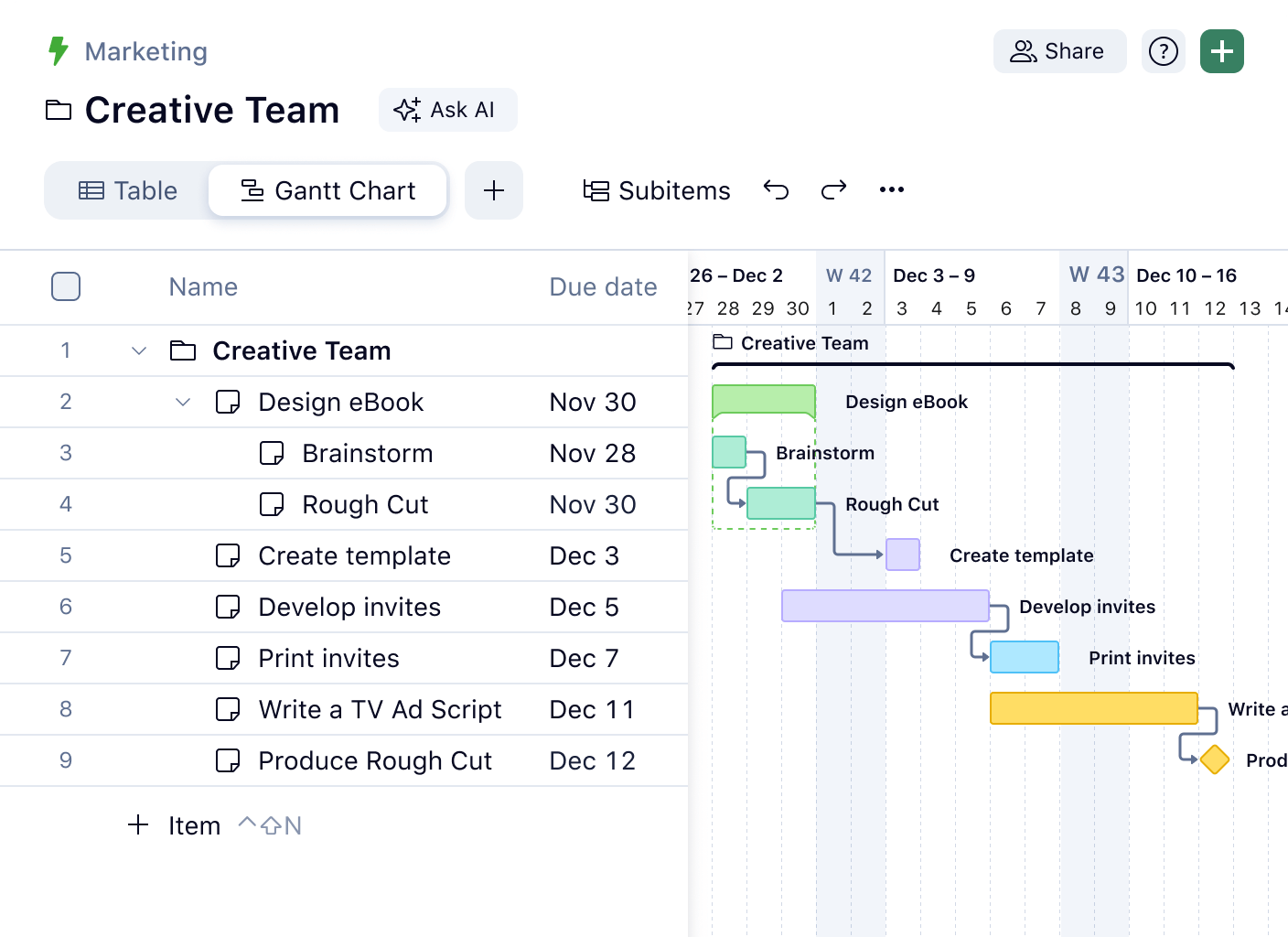
Automated report creation removes another common source of project delays. Instead of a project manager manually pulling together a status update each week, Wrike can generate performance reports automatically from your project’s real-time data. And with interactive Gantt charts, timelines can be adjusted on the fly rather than rebuilt from scratch whenever something changes.
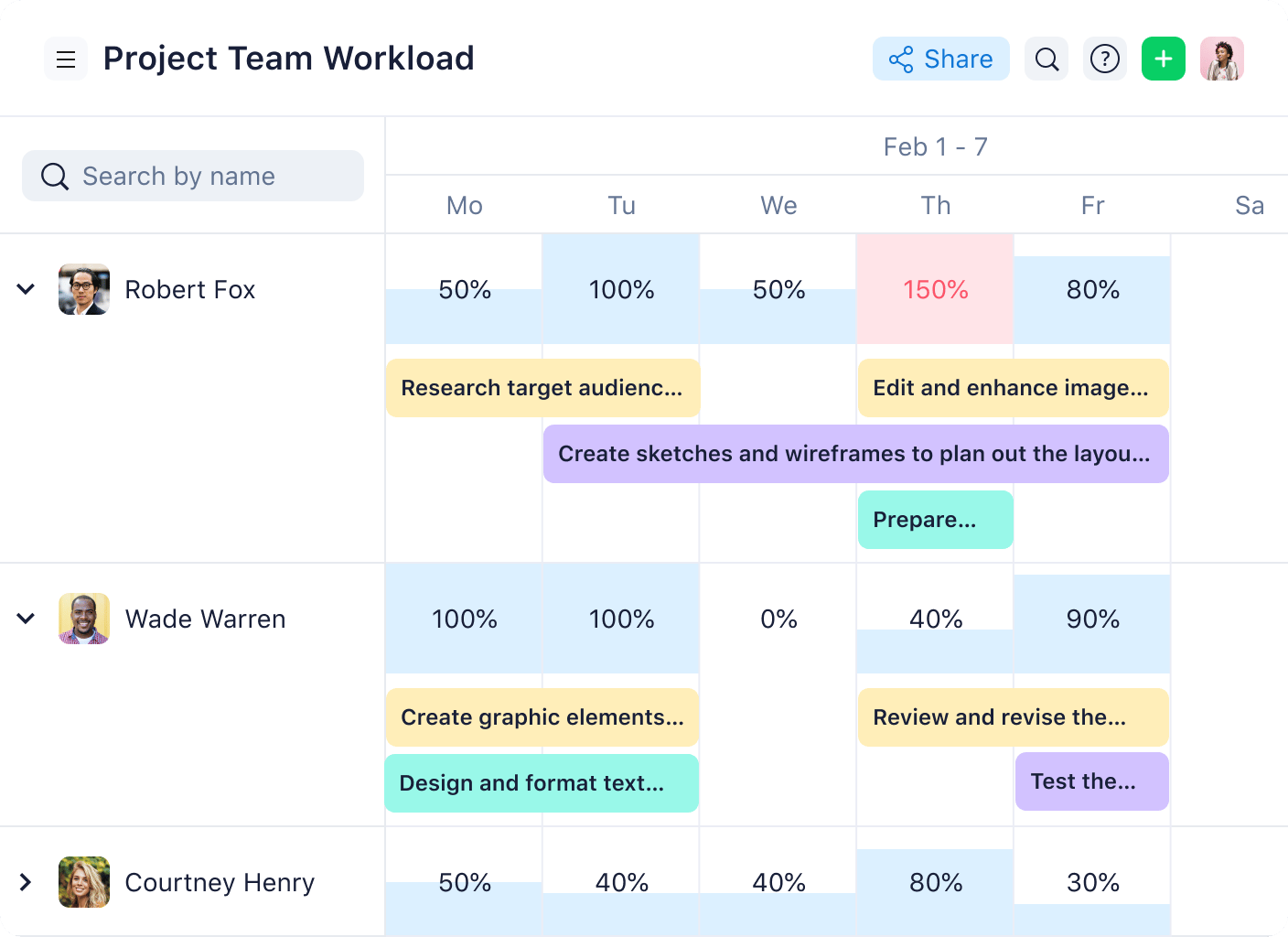
For accurate capacity planning, Wrike generates overviews of each team’s workload, letting managers see at a glance who has room to take on new work. This helps avoid the kind of overallocation that slows a project down and eats into its ROI.
Reduce errors
Project errors are expensive. They lead to reworks, missed deadlines, and decisions made on bad information, all of which erode a project’s ROI. Wrike addresses this on several different fronts:
- Our approval software ensures work meets your company’s standards before it moves forward, routing it to the right approvers and keeping a clear paper trail of who signed off on what and when.
- Built-in proofing and version control on creative or document files, so teams aren’t sharing or working on outdated drafts by mistake.
- Real-time project dashboards that give managers the latest project information as decisions are being made, not a snapshot from last week’s status meeting.
This also supports better risk management. With real-time visibility into where a project actually stands, teams can catch problems while there’s still time to course-correct, instead of discovering them after the budget’s already blown.
Centralize communication
Wrike streamlines communication to improve ROI. Integrations with the tools your team already relies on, like Slack, Microsoft Teams, and Zoom, keep updates, comments, and approvals visible without extra manual follow-up, and email integrations mean stakeholders who don’t need daily access to Wrike can stay looped in and respond to requests right from their inbox.

Plus, automated reminders and personal dashboards ensure each person on a project sees exactly what’s relevant to them, without having to dig for it. With that visibility built in, teams often find they need far fewer status meetings to stay aligned, freeing up hours that would otherwise go toward simply keeping everyone in the loop.
Automate manual processes
Automation’s role in ROI is straightforward: it frees up your team’s time for the work that actually needs a human touch, instead of the repetitive admin surrounding it.
With Wrike, custom, automated intake processes route new requests, such as a campaign brief or a change order, straight to the right person or team, rather than sitting in an inbox waiting to be manually triaged.
From there, workflows can run end-to-end through integrations with the other tools your team already uses. This includes financial tools like QuickBooks, so approved work can feed directly into invoicing and time tracking without manual re-entry, and CRMs like Salesforce, keeping sales and delivery teams working from the same up-to-date project information.
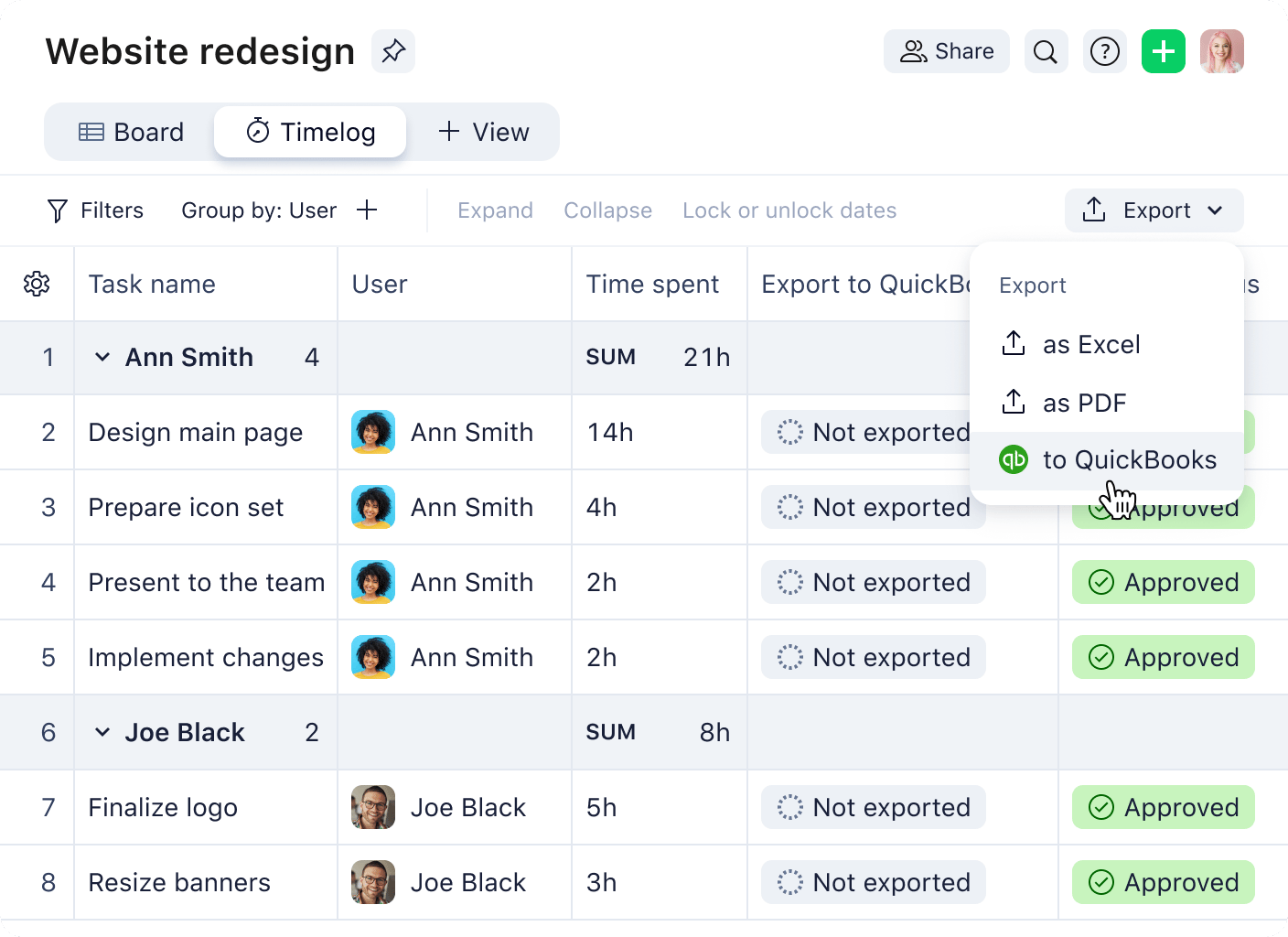
The result is fewer hours spent on coordination and more spent on the parts of the project that actually move the needle on ROI.
Find out how much time and money you can save with Wrike
By now, you’ve got a clear picture of what project ROI is, how to calculate it, and where the common pitfalls lie. The next step is seeing what it could look like for your own projects.
With Wrike’s ROI calculator, you can compare your ROI on paper versus the actual ROI, after factoring in busywork, rework, and delays that most calculations miss.

You can also see real-life examples of companies that have used Wrike to achieve measurable and sustainable ROI improvements, including:
- Wearable tech pioneer Fitbit saves 400 hours of meetings per year and spends 50% less time on project management, specifically on timeline building and management.
- Digital marketing agency Jellyfish saves 3–5 hours per week on individual workload and reduces time spent on client call summaries by 95%.
- Healthcare company OSF completes creative projects 50% faster on average.
- Recruiting company Aerotek cuts weeks from its average project planning time and reduces the number of emails it sends by 85–90%.
If you’d like to see how Wrike could work for your team’s unique projects, book a demo or start your free trial now.
Frequently asked questions (FAQs) about project ROI
What counts as a good ROI for a project?
There’s no universal benchmark for a good ROI, since it depends heavily on the industry, the size of the investment, and how long the return takes to materialize. Instead of chasing a fixed number, it’s usually more useful to compare a project’s ROI against similar past projects or industry peers.
How is project ROI different from portfolio or company-wide ROI?
Project ROI measures the return on a single, specific initiative, while portfolio or company-wide ROI looks at the combined return across many projects or the business as a whole. A company can have a strong portfolio ROI even if a few individual projects underperform, since gains elsewhere balance it out.
Can you calculate ROI before a project even starts?
Yes, you can calculate ROI before a project begins. This is often called anticipated ROI, and it’s built from projected costs and expected benefits rather than actual results. It’s useful for deciding whether a project is worth pursuing, though it should be treated as an estimate that the manager refines as real numbers come in.
What’s the difference between ROI and payback period?
ROI measures how profitable a project is overall, while the payback period measures how long it takes to recoup the original investment. A project can have a strong ROI but a slow payback period, or vice versa, which is why it helps to look at both together.
Does a low or negative ROI mean a project failed?
A low ROI in isolation doesn’t necessarily mean that a project has failed. A project can still be worthwhile if it produced intangible benefits, supported a longer-term strategy, or was essential to the business despite a weaker financial performance. Context matters just as much as the number itself.