

Key takeaways:
- The right project management platform should do more than connect to Slack and Google Workspace: It should let you create tasks, route approvals, and automate handoffs directly inside those tools.
- Wrike is the strongest overall pick for teams that need deep Slack and Google integrations paired with enterprise-grade security, automation, and resource planning.
- Other solid options depend on your use case: Asana and Monday.com suit cross-functional collaboration, Jira fits software teams, and ClickUp delivers feature depth on a tighter budget.
- When evaluating platforms, think in three tiers: core connectivity (notifications and file linking), bi-directional action (message-to-task creation), and strategic orchestration (two-way data sync and multi-app automation).
- Security can’t be an afterthought: SSO, two-factor authentication, audit logs, and granular permissions are essential for any team scaling integrations across departments.
- Pricing comparison goes beyond per-user cost: Check whether Slack and Google integrations are included in base plans or gated behind higher tiers alongside automation and admin features.
If your team is anything like ours, Slack is always running in the background, and you’d be lost without your Google Workspace. They’re incredibly useful tools, but the time it takes to switch between them can really add up if you don’t have the right project management platform.
When you’re on the hunt for project management software, you want to make sure you choose the right option that will integrate smoothly with both Slack and Google Workspace. The goal is to go beyond finding a tool that connects to your stack to one that operationalizes it.
If you can land on that sweet spot, you’ll end up with fewer status meetings, less manual entry, and better on-time delivery. By bringing your project management into the tools your team already uses for communication, you can cut out that extra admin time and let the work flow naturally.
After careful research, we compiled an expert guide to the top 10 project management platforms integrated with Slack and Google Workspace. Let’s dive into these platforms that turn everyday tools into high-velocity execution engines.
How we evaluated the platforms
We analyzed these platforms based on their ability to amplify communication and productivity, specifically within Slack and Google. However, for a tool to be truly enterprise-ready, we also required it to meet high standards for:
- Workflow automation: Reducing manual handoffs between workflow apps
- Resource planning: Providing visibility into team capacity
- Security and governance: Ensuring IT-approved controls like SSO and audit trails
We assessed each platform on:
- Slack integration depth
- Google Workspace integration depth
- Bi-directional workflow actions
- Automation and orchestration
- Security and admin controls
- Scalability for cross-functional teams

Which platform is best for Slack and Google Workspace users?
Wrike is one of the strongest project management platforms for teams that rely on both Slack and Google Workspace, hands down. Wrike combines native integrations, task creation from Slack, Google Drive collaboration, automation, and enterprise governance — all in one system.
You’ll find other strong options include Asana, Monday.com, ClickUp, Smartsheet, and Jira.
Best project management platforms for Slack and Google Workspace by use case
The leaderboard varies by use case, so make sure you carefully consider how you’ll use your new project management platform.
Here’s how each platform ranks based on use case:
- Best for enterprise teams: Wrike
- Best for intuitive cross-functional work: Asana
- Best for visual workflow automation: Monday.com
- Best for feature depth on a budget: ClickUp
- Best for process-heavy operations teams: Smartsheet
- Best for software teams: Jira
- Best for documentation-first collaboration: Notion
- Best for creative teams: Hive
- Best for simple small-team collaboration: Basecamp
- Best for Zoho ecosystem users: Zoho Projects
Wrike
First up, Wrike. Wrike stands out for enterprises that need robust, secure integrations with Slack and Google Workspace, along with powerful automation and governance. The native Wrike app for Slack lets users create and update tasks directly from channels, and it posts real-time notifications. That means you can take a Slack message and turn it directly into an actionable task in Wrike with just a few clicks — and vice versa!
Instead of manually copying updates into a Slack channel, you can share status information with stakeholders with a single click from inside Wrike.
To get a better understanding of how the Wrike and Slack integration works, check out this video:
On the Google Drive front, Wrike’s integration is also very strong. For file-centric workflows, Wrike’s Google Drive integration links and previews assets so teams can collaborate without duplicating content. Wrike Integrate takes this further with no-code, app-to-app automations that orchestrate complex, multi-system workflows across departments.
Beyond integrations, Wrike provides enterprise-grade depth: real-time proofing and approvals, resource and capacity planning, multiple project views (Gantt, Board, Table, Calendar, Chart), and built-in time tracking — all designed to increase output and visibility at scale.
Security is anchored in SSO, two-factor authentication, encryption, granular permissions, and comprehensive admin controls. Trusted by over 20,000 customers worldwide, Wrike offers flexible pricing tiers for teams of all sizes.
Wrike at a glance for Slack and Google integration
|
Category |
Highlights |
|
Integration method |
Native Slack and Google Workspace integrations; two-way notifications; Wrike Integrate for no-code automations and app-to-app connections |
|
View types supported |
Gantt, Kanban/Board, Table, Calendar, Chart |
|
Admin and security |
SSO, 2FA, encryption, granular permissions, audit, and admin controls |
|
AI capabilities |
Wrike AI, including Wrike Copilot and custom AI automations embedded in tasks and workflows |
|
Key pricing tiers |
Free, Team ($10), Business ($25), Enterprise/Apex (custom pricing) |
Asana
Asana is known for its intuitive cross-team work tracking and mature app integrations. Its Slack integration pushes actionable notifications to channels and DMs, and supports quick task creation from messages. Asana’s Google Workspace integrations link files from Drive and surface Docs, Sheets, and Slides in context.
Cross-platform notification synchronization ensures updates remain consistent, reducing duplicates and missed alerts across tools. For integration-focused leaders, Asana’s goals, portfolios, and workload views provide a top-down lens on progress and capacity, all with a UI that’s approachable for teams new to automation.
Monday.com
Monday.com offers flexible, visual workflows with automations that connect directly to Slack and Google Workspace. Boards can reflect marketing calendars, creative pipelines, and task backlogs, while no-code rules route updates into Slack channels or create items from Slack threads.
Google Drive and Google Calendar integrations keep assets and timelines visible to stakeholders. Monday.com’s differentiator is workflow automation. It supports modular “if-this-then-that” recipes that reduce status-pinging and accelerate handoffs.
ClickUp
ClickUp is a feature-rich choice for budget-conscious teams that want tasks, docs, and chat in one place. The ClickUp Slack integration supports message-to-task conversion and alerting, while Google Workspace integrations connect Drive files and allow document collaboration alongside tasks.
ClickUp’s consolidated toolset can cut tooling costs for smaller teams without sacrificing integration depth.
ClickUp integration snapshot for smaller teams
|
Integration area |
What you can do |
|
Slack |
Create tasks from messages, receive task updates in channels/DMs, and unfurl task previews |
|
Google Workspace |
Attach Drive files, co-edit Docs/Sheets, and mirror key dates to Calendar |
Smartsheet
Smartsheet applies a process-driven, spreadsheet-style model to project and portfolio work, making it ideal for operations-heavy teams. Its grid-style project management mirrors familiar views and formulas while layering on automation, dependencies, and reporting.
Google Workspace integrations sync Sheets, Drive, and Calendar, while Slack integrations trigger alerts, status changes, and lightweight approvals in channels. For PMOs standardizing repeatable processes, Smartsheet’s templates and automations stand out.
Jira Software
Jira Software is the go-to for Agile software and product teams that require robust issue tracking and developer-centric workflows. Slack integrations stream issue notifications to squads, enable create/update actions from threads, and keep standups in channels.
Google Drive integrations connect specs, design artifacts, and user stories to epics and issues. Agile automation rules tie it together with sprints, releases, and code-related triggers.
Here’s a typical Slack/Google automation flow in Jira:
- Convert a Slack message into a bug with assignee/labels
- Post sprint changes and deployment statuses to a team channel
- Attach Drive-hosted PRDs and design files to epics, auto-update links on version change
- Mirror release dates to Google Calendar for stakeholder visibility
Notion
Notion combines collaborative docs, databases, and lightweight boards, making it suitable for knowledge-centric teams that also run straightforward projects. Slack notifications and message-to-page/task flows, along with Google Drive embeds and link previews, keep knowledge and tasks connected.
The outcome is an affordable, flexible workspace that centralizes wikis, meeting notes, and backlog items without heavy admin overhead.
Hive
Hive targets creative and marketing teams with robust integrations, proofing, and built-in chat. Slack and Google Workspace connections streamline asset sharing and feedback loops, while AI-powered automation helps generate tasks from briefs and route approvals.
For teams immersed in visual campaigns and rapid iterations, Hive’s proofing, in-app chats, and time tracking all help reduce context switching.
Basecamp
Basecamp offers a simplicity-first approach, combining to-dos, messages, schedules, and documents in a clean package. Slack connectivity is typically managed via connectors that push to-do updates or announcements into channels, while Google Drive embeds keep files centralized.
Basecamp is an excellent choice for small teams seeking uncluttered, low-admin collaboration, but if you require deep automation, granular permissions, or resource planning, you might find more advanced platforms better suited.
Zoho Projects
Zoho Projects delivers strong value, especially for small and medium businesses and organizations already using Zoho apps. Direct Slack and Google Workspace integrations support task updates, file attachments, and calendar sync, while tight integration with Zoho’s broader suite (CRM, Desk, Analytics) creates a cohesive ecosystem.
Key differentiators:
- Cost-effective plans within a broader business app stack
- Native ties to Zoho tools for lead-to-project and support-to-project flows
- Solid core PM features with extensibility via marketplace apps
How to choose the right project management platform for Slack and Google Workspace integration
Reading through those ten project management platform rundowns might have turned your brain into integration mush. That’s why it’s important to follow a structured evaluation that aligns tools with your actual workflows. We’ve also put together a simple decision matrix you can use to note down the differences between your top contenders. You’ll find that below.
First, here’s a structured evaluation process you can follow:
-
Map your requirements
- Identify the Slack channels and Google assets (Drive folders, Calendars) tied to mission-critical work.
- Define automation depth: notifications only, message-to-task, approvals, or multi-app workflows.
- Consider team scale, project management skills, and reporting cadence across departments.
-
Test with real scenarios
- Pilot free or basic tiers to simulate actual processes, including message-to-task flows and Drive-based approvals. Many vendors encourage trying real-world use cases before committing.
-
Validate enterprise needs
- Confirm SSO, 2FA, audit logs, encryption, data residency, and admin delegation.
- Check resource planning, portfolio views, and the breadth of analytics.
- Model total cost per user, including add-ons.
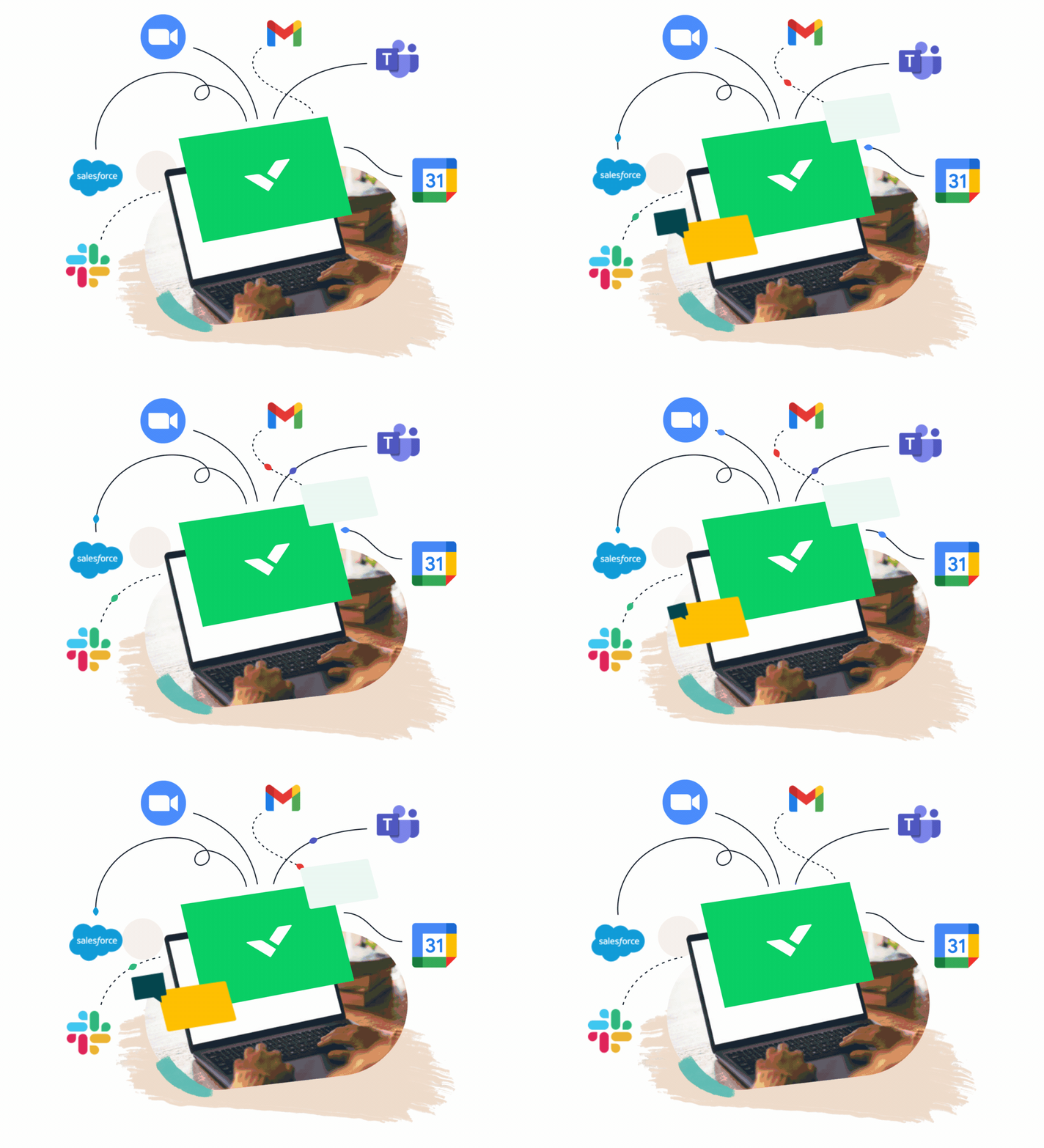
Use this simple decision matrix to evaluate different project management software platforms. If you weigh columns by importance, depending on your personal workflow needs, you’ll have a better understanding of which platform best suits your needs.
Decision matrix
|
Platform |
Slack integration depth |
Google Workspace depth |
Security/SSO |
Automation power |
Scalability |
|
Candidate A |
|
|
|
|
|
|
Candidate B |
|
|
|
|
|
|
Candidate C |
|
|
|
|
|
Score each candidate from 1-5, with 5 being the highest value
Key features to look for in Slack and Google Workspace project management integrations
Once you’ve evaluated the different project management platforms for your needs, double-check your frontrunners against this power-user checklist.
The integration power-user checklist
Use this list to audit your potential choices. A system of work should do more than just send notifications; it should meet these three critical categories:
☐ Tier 1: Core connectivity: Real-time Slack notifications for @mentions and automated Google Drive file linking within tasks.
☐ Tier 2: Bi-directional action: Turning a Slack message into a task with two clicks and unfurling links to show task owners and statuses.
☐ Tier 3: Strategic orchestration: Two-way data sync (changes in a Google Sheet reflect in the project tool) and app-to-app automation to handle cross-departmental handoffs.

Pricing considerations for integrated project management platforms
Most platforms price per user, per month, with advanced integrations, automations, or security often gated to higher tiers or add-ons. Wrike’s plans are transparent: Free ($0), Team ($10), Business ($25), and Enterprise/Apex (custom pricing). Each tier includes native Slack and Google integrations, and advanced automation/security capabilities expand with each tier.
When comparing pricing, don’t just look at per-user cost. Also check whether Slack and Google Workspace integrations are included in the base plan, limited by tier, or tied to broader automation, admin, and security features.
|
Platform |
Starting price/tier |
Slack + Google integration access |
Pricing note |
|
Wrike |
Free; Team $10; Business $25; Enterprise/Custom |
Native Slack and Google integrations included; advanced automation, admin, and security expand by tier |
Strong transparency; more value comes at higher tiers if you need governance, automation, and scale |
|
Asana |
See vendor pricing |
Slack and Google Workspace integrations available; access and advanced capabilities vary by plan |
Good fit for cross-functional teams, but check which automation and admin controls are gated |
|
Monday.com |
See vendor pricing |
Slack and Google integrations available; automation volume and advanced features depend on plan |
Watch for limits tied to plan level, especially around automation and scale |
|
ClickUp |
See vendor pricing |
Slack and Google integrations supported; configuration depth depends on workspace setup and tier |
Flexible option, but teams should confirm which advanced workflow capabilities are included |
|
Smartsheet |
See vendor pricing |
Slack and Google integrations supported; enterprise-oriented controls depend on plan |
Better suited to structured operational workflows, so value depends on process complexity |
|
Jira Software |
See vendor pricing |
Slack and Google integrations available through native and ecosystem options; depth varies by setup |
Stronger fit for software teams than general business teams, so price-to-value depends on use case |
|
Notion |
See vendor pricing |
Slack notifications and Google Workspace connectivity available, but workflow depth is lighter |
Works better for documentation and lightweight coordination than advanced cross-functional execution |
|
Hive |
See vendor pricing |
Slack and Google integrations supported; depth varies depending on workflow needs |
Better for collaboration-focused teams, but evaluate scale and admin needs carefully |
|
Basecamp |
See vendor pricing |
Basic integration support available, but less depth than more enterprise-focused platforms |
Simpler option for small teams, but may not justify cost if advanced workflow control is needed |
|
Zoho Projects |
See vendor pricing |
Slack and Google integrations supported, especially for teams already in the Zoho ecosystem |
Can be cost-effective in the Zoho stack, but broader fit depends on ecosystem preference |
Overall, the comparison points to a few clear differences across the 10 platforms:
- Wrike offers the broadest combination of connectivity, proofing, orchestration, and enterprise security.
- Asana and Monday.com are strong for cross-functional collaboration and workflow visibility.
- Jira is best suited to software teams, while Notion and Basecamp are better for lighter coordination.
Security and compliance in Slack and Google Workspace integrations
For enterprises, integration power must be matched by security. It isn’t enough to connect the apps; IT must be able to govern them.
Look for:
- Authentication: SSO (SAML 2.0) and 2FA are essential for scaling safely.
- Governance: Admin controls that determine who can connect to which Slack workspaces or Google Drives.
- Auditability: Exportable audit logs to track integration activity and file sharing.
- Encryption: Both in transit and at rest
- Compliance: Certifications, as well as data residency options
Wrike supports SSO, 2FA, encryption, permissions, and enterprise-grade admin and audit features.
Our recommendation for Slack and Google Workspace users
If you only need simple notifications, several of these project management platforms can work. However, if you need task creation, asset collaboration, approvals, workflow automation, security, and scale in one place, Wrike is the strongest fit.
Wrike is especially suitable for mid-market and enterprise teams that need more than just lightweight integrations.
Interested in seeing these integrations in action? Start your 14-day free trial of Wrike today and experience firsthand how a unified workspace can transform your team’s productivity.
Frequently asked questions
How do project management tools integrate with Slack and Google Workspace?
Project management tools leverage app connectors, bots, and APIs to synchronize task updates, file sharing, and notifications across Slack and Google Workspace, keeping teams aligned in real time.
What are the benefits of using project management platforms with Slack and Google Workspace?
You gain faster communication, centralized document access, and automated updates that reduce manual data entry and enhance productivity.
How can I customize notifications and alerts in integrated platforms?
Most tools let you select which activities trigger Slack or Google alerts and where they appear, so you see what matters without unnecessary noise.
What project views and collaboration features are typically available in these platforms?
Common views include Kanban boards, Gantt charts, tables, and calendars; collaboration features typically include comments, file sharing, and real-time editing.
How do enterprise security features impact tool integration choices?
SSO, 2FA, and audit logging help secure Slack and Google integrations, giving admins the controls needed to scale safely.