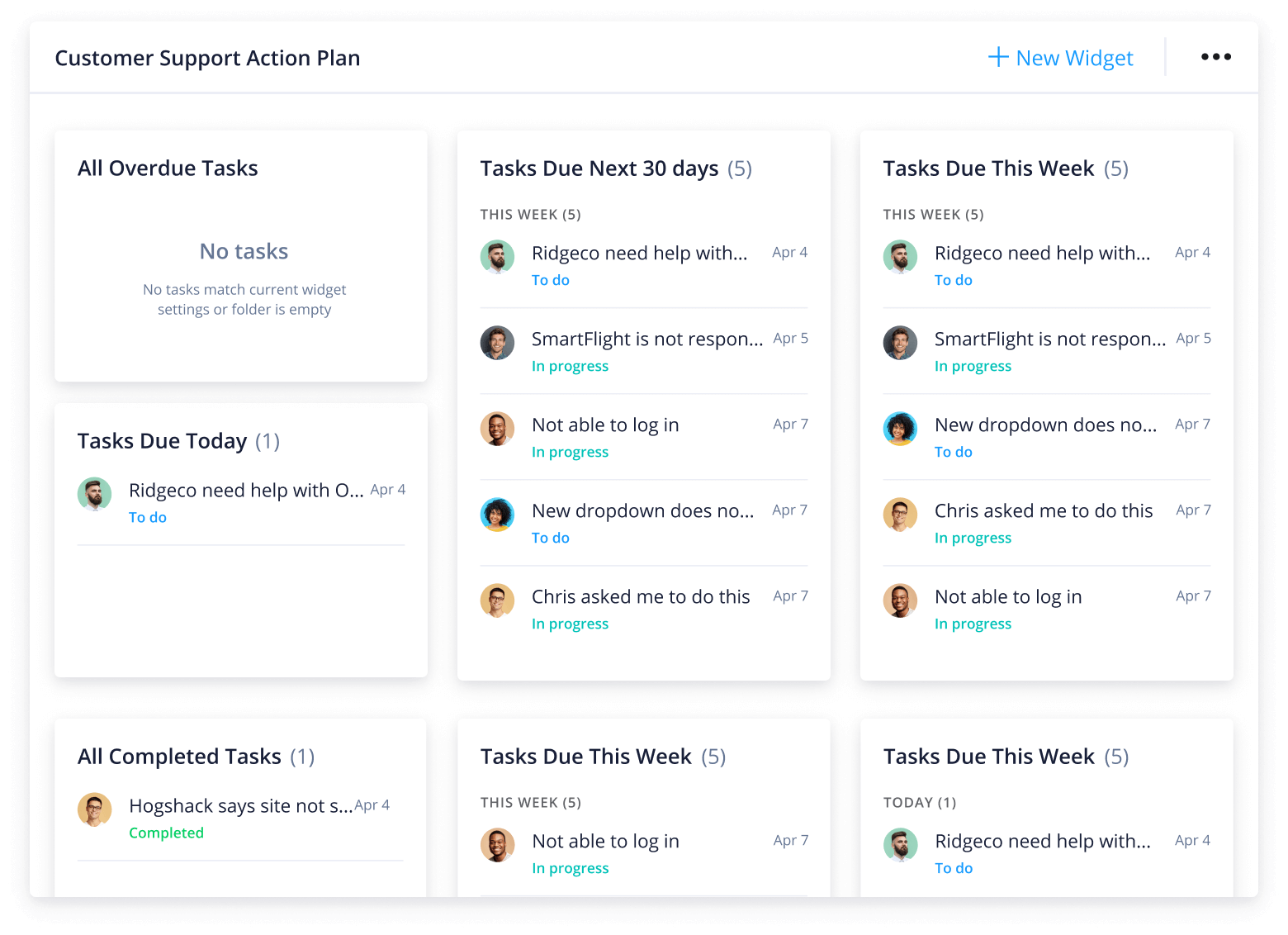
When it’s time to conduct a quarterly business review, tracking your team’s progress is the main goal. Our QBR template allows you to assess and review developments and present them to key stakeholders.
Do you struggle with these activities?
Showcasing progress for regular team reviews
Organizing the task creation process
Tracking requested actions
Eliminate these obstacles with Wrike’s QBR template.
Use the QBR agenda template to ensure all essential topics relevant to meeting attendees are covered
Share your QBR template ahead of the meeting to allow stakeholders make informed decisions more quickly
Detail tasks that result from the QBR in your template and assign accountability to each one
Why you need this QBR template
Collate important details
Is your work scattered in various locations? Meetings can be disorganized if you don’t have the relevant information at your fingertips. Use our QBR agenda template to ensure nothing is missed. Keep information in a single location, so progress can easily be shown to stakeholders.
Summarize objectives
This QBR template makes it easy to visualize where work has been successful and where things might not have performed as intended. By collating previous and current data, you can assess where necessary changes could be made and which objectives can be updated.
Identify potential risks
A major benefit of QBR templates is helping teams visualize why something might have gone wrong previously and what could go wrong in the future. Keep minutes from your last QBR meeting in your current template to note any patterns and identify potential risks that could be avoided.
How to use the quarterly business review template in Wrike
Struggling with chaotic quarterly meetings? The QBR template in Wrike helps your team get the most out of meetings by creating a single location to store agenda items, view actionable follow-up tasks, and share progress with stakeholders.
Wrike’s QBR template is simple to use. This template has three clear steps to get you started.
Step 1: Set the meeting agenda
Start by setting your QBR meeting agenda, including tasks that have been completed or are in progress. Link documents and files to these tasks to show stakeholders the effort your team put in and the results you achieved.
Step 2: Create actionable tasks
During your QBR meeting, you can quickly and easily create actionable tasks and assign them to team members, so no agenda item gets overlooked or neglected until the next QBR. Delineate tasks by department or topic so stakeholders can keep tabs on them, and use the pre-built workflow to move tasks forward.
Step 3: Monitor progress
Once the QBR has taken place, monitor the progress of your action items with a variety of different customizable views, including dashboards, calendars, and Gantt charts. Keep track of each item to ensure it progresses before the next QBR meeting.
Make Wrike work for you
Interested in the other ways Wrike can streamline your workload? Wrike’s powerful project management software can improve your processes, supercharge progress, and unify your team in a single platform. Our powerful features include:
Wrike is designed to help you work in a way that suits your team. Each feature is highly customizable to meet the needs of any project, team, or organization.
Resources for project managers
Case study
Find out how the City of Reno improved efficiency and innovation across multiple departments with Wrike
This template is used to collate agenda items and project highlights for QBR meetings. You can also set actionable tasks and track their progress with dashboard, calendar, and Gantt chart views.
The QBR template creates a single location to store agenda items, evidence, documents, and files, so they can be shared with stakeholders ahead of time. During the QBR meeting, attendees can make decisions more efficiently and effectively.
Teams of any size and in any industry can benefit from the QBR template. The template’s features are designed to be customized for any QBR meeting.
How to install this template in your account
You can only access this template when you create a new space. You can access the use case templates gallery through the space creation wizard. When you opt to create a new space, the template gallery opens by default.
Click the “+” button in the upper-right corner of your workspace.
Select “Space.”
On the page that opens, hover over the use case you want and click “Preview.” Look for the “QBR” template in the list (use the search bar if needed).
Now, you can see more information about the use case. Click “Select” to create a space.
Yes, there are.
To use this template, you need to have at least the Business plan or up. Check our plans here.
You must have the required permission to create a public space in your account.
If the template contains account-level custom fields, custom item types, workflows, request forms, or automation, you must have the permission required to create those items.
This template is only available when the workspace language is set to English.
Check the prerequisites above. If you don’t match one of the prerequisites, talk to your space admin or your account owner. If you match all the prerequisites and you still can’t see the “QBR“ template, feel free to reach out to the Wrike support team.
Unlock the power of Wrike’s templates
Use our smart search tool to explore versatile templates, designed for easy customization and streamlined project management.
Wrike enhances its website search experience using Google's Vertex AI Search and Conversation generative AI service. Users are cautioned that generative AI might produce inappropriate, inaccurate, offensive, or unintended results, and are advised against submitting explicit, harmful, offensive, or illegal content as search input. Neither Wrike nor Google uses your search inputs to train its machine learning models or for advertising purposes, but search activities may be collected and/or stored via cookies in accordance with our Privacy Policy if you previously registered on our website. These cookies can be deleted through your browser settings. Wrike's search service is not designed to be used in connection with your personal data or any sensitive data of any kind, which users must refrain from inputting.