


Significant changes are taking place in project management today. Some of the world’s most dynamic organizations like The New York Times, Tribune Co., and Ernst & Young have switched from the so-called top-down management style to bottom-up management. Even behemoths like Toyota and IBM have implemented bottom-up management-style elements in many of their departments.
Despite the rising popularity of the bottom-up approach, discussions about which of these two major approaches is best rage on. Why have companies become so anxious about changing their management style, and which one is right for your organization?
Managing Projects Top-Down
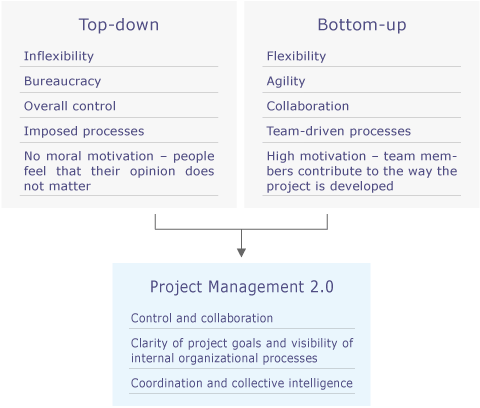
“Top-down” means that all the project objectives, guidelines, information, plans, and fund processes are established by management, and expectations are communicated down to each project participant. This approach requires extreme process formality, as any ambiguity can easily result in misunderstandings and project failure.
The New York Times, a leader in the newspaper industry, used the top-down approach for many years. But American Journalism Review reported that The Times’ executive management felt that they were far from what was necessary for the creation of a vibrant workplace and a successful organization. Power was centralized and masthead editors had overall control. Editors introduced the same management pattern in the projects for which they were responsible. One person’s emotions and opinions influenced all the project decisions, and that person was the project manager.
As a result, team members felt that they weren’t heard, and their voices didn’t count. Collaboration between journalists was nonexistent. Managing executives realized that they needed to give more freedom to the teams and change their project management implementation style. It took quite a while to introduce bottom-up management to the organization, but The New York Times employees say that collaboration has improved greatly, and team members now work together more productively and efficiently.
Similar problems can be seen at other organizations that stick to traditional management styles. Top-down management often causes bottlenecks and results in reduced productivity. When project managers have total control over teams, they can cause lockdowns that lead to unnecessary frustration and stress and can significantly slow down a project’s completion.
Bottom-Up Project Management Options
The obvious drawbacks and limitations of top-down management have motivated many organizations to adopt bottom-up management styles. The bottom-up approach requires proactive team input in every step of the management and project executing process. The whole team is invited to share in the decisions of which course of action to take.
The bottom-up style allows managers to communicate goals and value through milestone planning, and team members are encouraged to develop personal to-do lists with the steps necessary to reach the milestones on their own. The team decides which methods they’ll use to perform their tasks.
A clear advantage of this approach is that it empowers team members to think more creatively.
Motivation to make the project a success is doubled because:
- They feel more involved in the project’s development and know that their input is appreciated.
- Individual team members can come up with project solutions that are focused more on practical requirements than on abstract notions.
- The planning process is facilitated by a number of people, which makes it flow significantly faster.
- Schedules, budgets, and results are transparent.
Bottom-up project management can also be viewed as a way of coping with the increasing gap between the information necessary to manage knowledge workers and the ability of managers to acquire and apply this information.
Despite all its the advantages, the bottom-up style alone will not make your projects flourish. It’s not the perfect solution and sometimes lacks clarity and control. The best way is to find a balance between the two opposite approaches and take the best practices from each.
Project management - The old way
Traditional project management tools were designed for the top-down approach and are not meant for bottom-up management. They’re focused on the project manager as the center of the project communications. Team members often have read-only access to the project plan and cannot make any contributions or changes directly.
The workflow ends up looking like this:
- The employees send their updates to the project manager in disconnected files via email.
- The project manager has to collect all the data and put the information manually into the project plan.
- Once gathered, the project manager has to communicate the changes to the corporate executives.
All these routine procedures bury the project manager’s talents, leaving little time for them to truly lead.
Project management 2.0
The good news is that the situation is changing. New tools and methods to successfully implement bottom-up management have emerged. These methods include enterprise 2.0 technologies — wikis, blogs, social networks, collaboration tools, etc. — that have changed the way organizations execute projects.
Project management 2.0 enables new patterns of collaboration that are based on collective intelligence, assembling valuable knowledge from the team experts in different fields. This knowledge is gathered and shared in a flexible, collaborative environment provided by second-generation project management software. The project manager can orchestrate the work of their team, and choose the right direction for the project development, based on feedback from individual employees.
The result is that people are less dependent on the manager as a “to-do” generator. Freed from their role of taskmaster, the project manager can become the project leader. They can facilitate team communications and provide a creative working environment.
The project manager then becomes a visionary, able to leverage the team strengths and weaknesses, and adjust the project development based on any internal or external changes. Individual team members still have the freedom and responsibility to find their way to the next milestone, but the project manager is now better able to help guide each team member.
Find your project management balance
With the help of this new generation of hybrid project management tools, managers can merge the advantages of the two approaches. These tools help them to combine control with collaboration, and clarity of project goals with internal, organizational visibility.
Thousands of companies attribute bottom-up project management, implemented with the help of enterprise 2.0 tools, to improving their business performance. Some companies created corporate blogs to streamline project communications. They introduced wikis to get their customers’ feedback. Even giants such as IBM realize the benefits of allowing contributors to have a more active hand in how collaborative work is organized.
Democratizing project management is never an end in itself. The primary goal is always to find ways to make project management and project collaboration more efficient. New technologies applied to projects make everything more successful and teams more productive. At the end of the day, projects are delivered faster, and this is to everyone’s benefit.
Wrike has been leading the charge for project management 2.0. For over a decade now, we’ve partnered with thousands of businesses, arming them with the tools and best practices necessary to become insanely productive and build Operational Excellence. We invite you to join the revolution and take your organization to the next level.