When business, team, and individual goals aren’t outlined effectively, your entire organization can have difficulty moving all work forward.
Does your company experience these issues?
Connecting individual work to company goals
Effectively aligning with the business on strategic planning
Monitoring progress throughout project life cycles
Eliminate these obstacles with Wrike’s OKR template
Connect specific work with high-level company objectives
Improve project and task execution
Keep track of individual, team, and company progress regularly
Why you need this template
Clarify goals
Are your goals simply too vague? Clearly record specific objectives and metrics for success, and determine which tactics and strategies will achieve them in Wrike.
Track progress
Does your team struggle to track progress, leaving no time to course-correct? Set up weekly, monthly, and quarterly check-ins with Wrike to monitor progress and adjust if things go off track.
Align teams
Is it difficult to see how your work affects strategic goals? Start with business objectives, then department, team, and individual goals. Link them together so everyone is aligned.
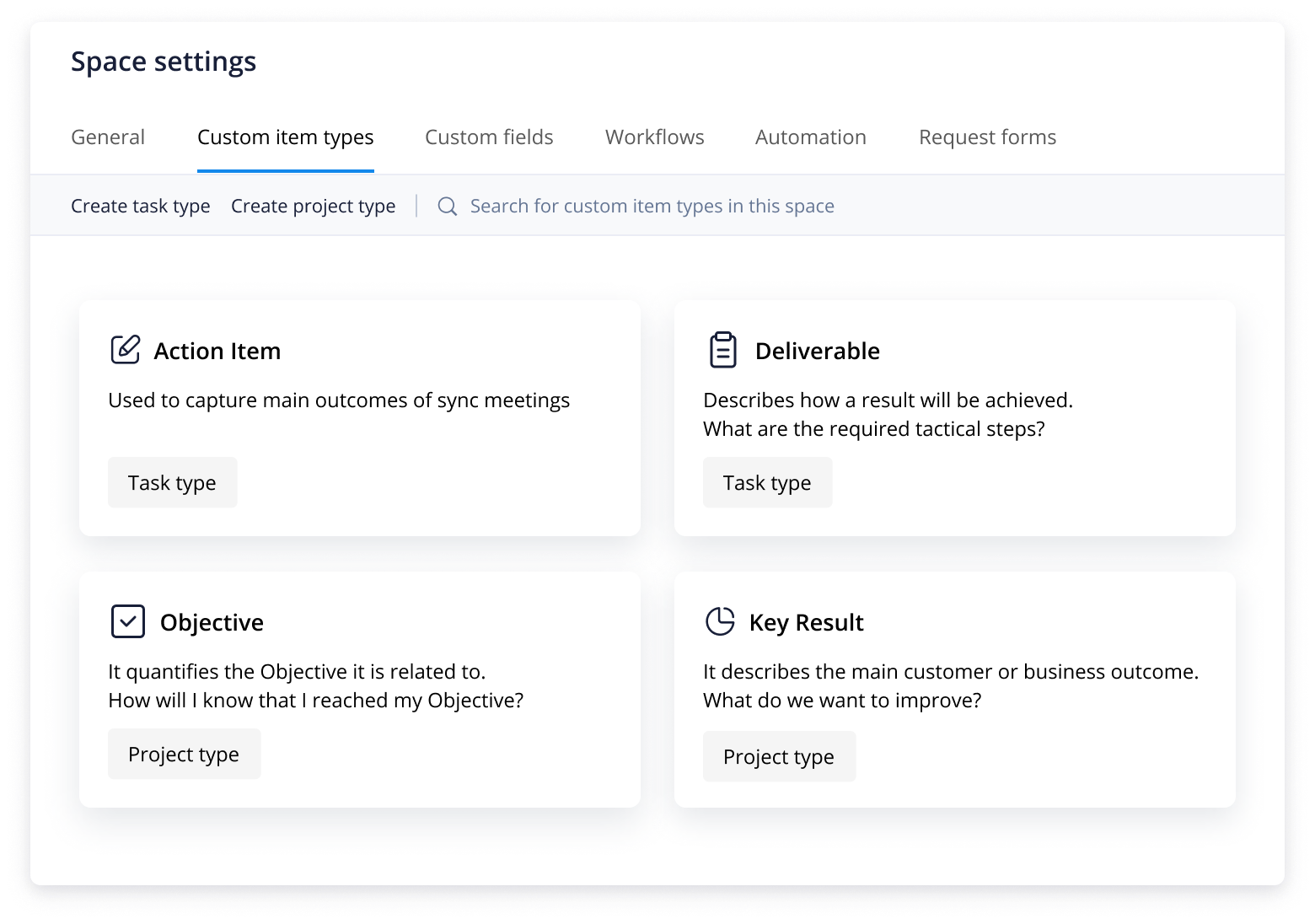
This template has multiple Custom Item Types to get you started, including Objectives, Key Results, Action Items, and Deliverables.
Companies often run into problems in strategic planning, such as setting unattainable targets, not making objectives clear to all stakeholders, executing work that doesn’t align to goals, or failing to track progress until the project has already derailed. Keeping OKRs organized and visible can be difficult, and teams often lack the structure for regularly monitoring progress against those OKRs. Wrike’s OKR template will help you create, organize, and monitor individual, team, and company goals.
Step 1: Build your OKR project
Hold an OKR planning session with your team to determine OKRs. Create new tasks in real time, add key details, and assign accountability for them. Organize them in a shared folder and create subtasks as necessary.
Create a public Space so all team members and stakeholders can have visibility into OKRs. Each team member can then consider their own contributions toward achieving team OKRs to further the company’s goals.
Step 2: Track your progress
This template comes with several Custom Item Types, which will help you get a jump-start on documenting and monitoring your progress.
These include:
Objectives and Key Results, which aid with clear documentation of your OKRs
Action Items, which you’ll use to assign tasks to team members
Deliverables, which will support OKRs for documentation
Step 3: Report OKR results
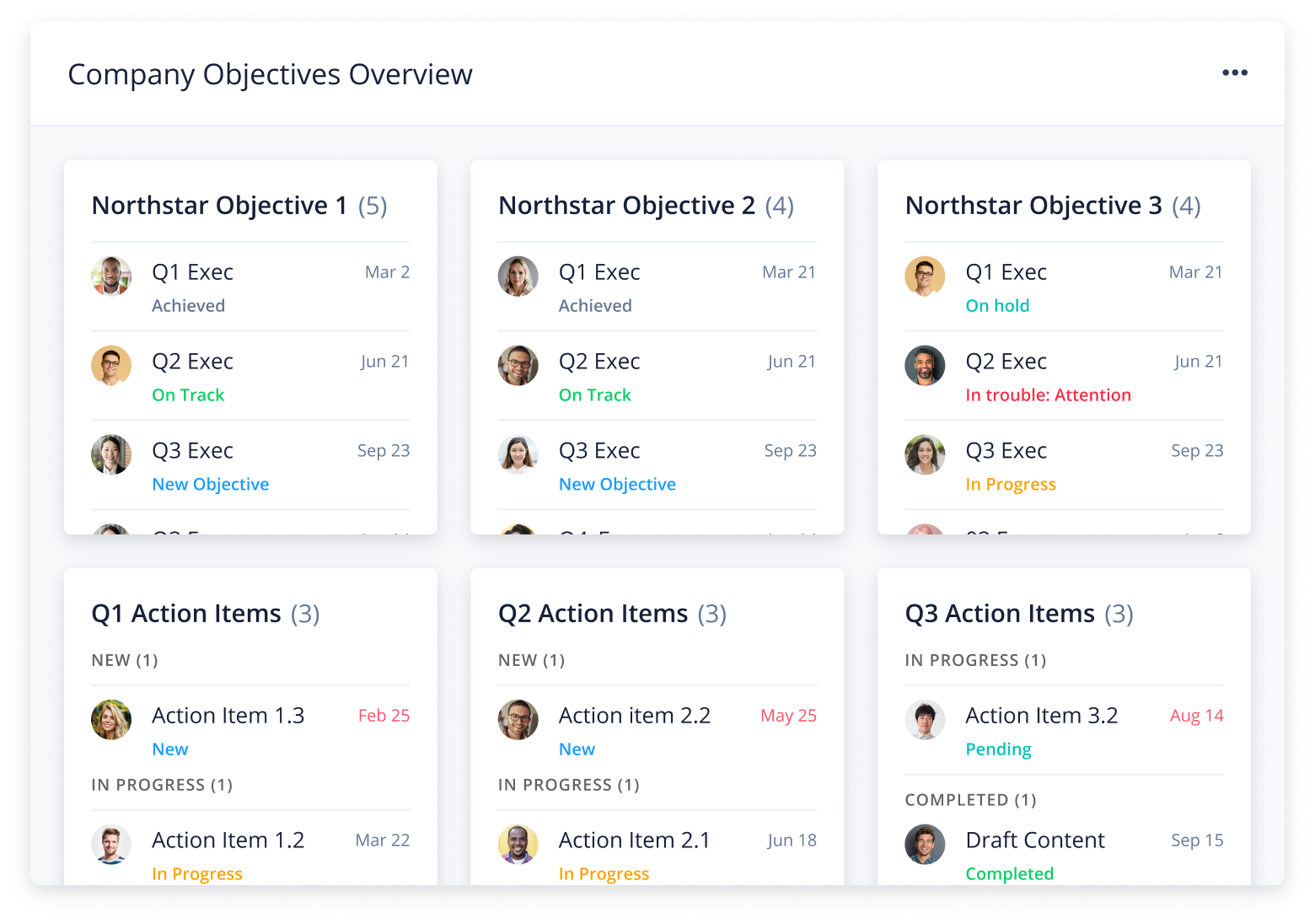
At the end of the quarter or year, it’s important to share OKR results to make adjustments for the next period. As you hit goals and mark subtasks as complete, the green progress bar will fill up, giving you a quick visual of how far you’ve come and how far you have yet to go.
Make Wrike work for you
Wrike can support your OKR planning, but did you know it could also help you streamline other parts of your work, from organizing meeting notes to employee time tracking?
Our powerful features include:
Shared Kanban boards
Versatile Gantt charts
Dynamic request forms
Whether you work for a small organization or a large company, Wrike can be tailored to suit the way you work. You can easily design a workspace that suits your project or team.
Check in with team members on the progress of their OKRs and use the template to record and update their status. For example, if your team member’s main OKR is to write four 10-page eBooks, then you can make each eBook a subtask. As these eBooks are completed and checked off, a green bar will fill up on the original OKR task, indicating percentage completion.
Use custom fields to track specific objectives or data. For instance, a sales team might use this feature to measure target completion for individual associates. At the end of the quarter, you can generate a report that reveals top-performing team members, sales averages, and ARR generated by individual associates.
Writing OKRs for project management is as simple as following our six-step process: 1. Build your team’s OKR template2. Create individual OKRs by setting up a template for each team member to use3. Discuss individual objectives and key results with managers to align goals from the bottom up4. Track and share progress, then make adjustments as needed to hit goals5. Assess performance and report on results6. Review results, celebrate successes, and learn from mistakes for the next project